2025 · GS Paper 3 · Q13 · 15 marks
Examine the factors responsible for depleting groundwater in India. What are the steps taken by the government to mitigate such depletion of groundwater ?
In short
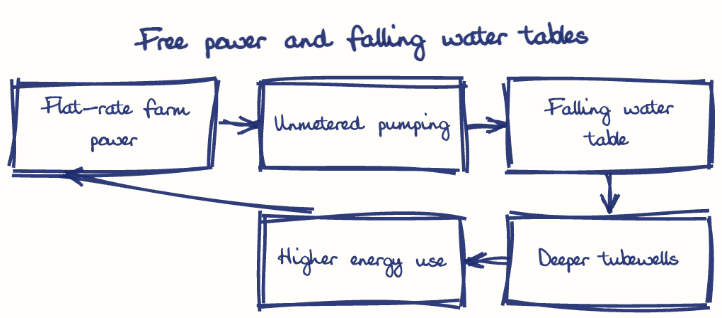
Groundwater in India is depleting because flat-rate farm power, MSP-backed paddy, land-linked pumping rights and shrinking recharge reward extraction, and the government now responds through aquifer mapping, recharge campaigns and regulation. The 2025 assessment found 730 of 6,762 units over-exploited, and Atal Bhujal Yojana manages demand through village water budgets.
Model answer
Ghissu Editorial · Verified 4 Oct 2026 · 274 words
Water-intensive cropping
MSP and assured procurement keep paddy and sugarcane in semi-arid Punjab and Haryana, helped by flat-rate power.
Weak legal control
The Indian Easements Act, 1882 ties groundwater to land ownership, allowing unlimited pumping.
Shrinking recharge
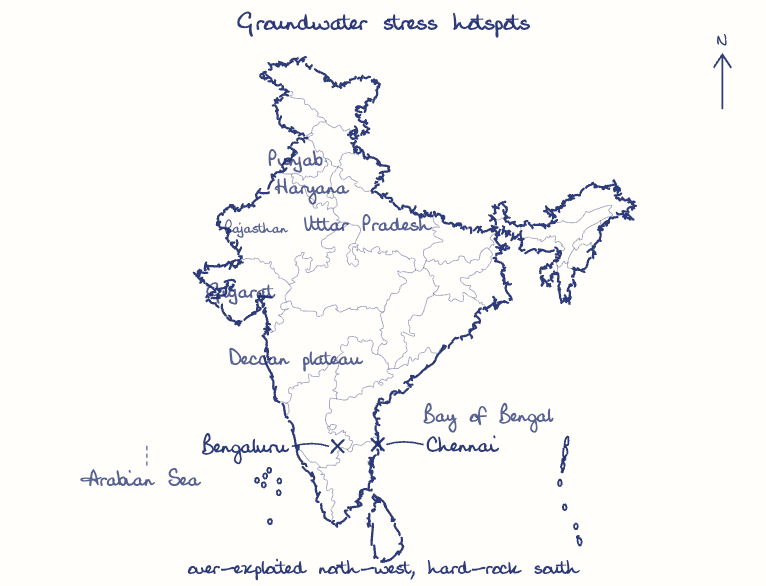
Concretisation and lost lakes cut infiltration, and Chennai's Purasaivakkam block extracts 158.61% of its recharge (CGWB, 2025).
Community management
Atal Bhujal Yojana (2019) ties incentives to water budgets in seven states, covering 2,835 gram panchayats in its 2025 assessment.
Mapping and monitoring
The National Aquifer Mapping and Management Programme and 43,228 monitoring stations track aquifers.
Recharge campaigns
Catch the Rain and Mission Amrit Sarovar build recharge ponds with public participation.
Regulation
CGWA guidelines (2020) require permits for industrial extraction, and Punjab's 2009 subsoil water law delays paddy transplanting.
Rational power pricing
Separate farm feeders as Gujarat's Jyotigram Yojana did and meter supply.
Crop diversification
Align MSP with water use, as Haryana's Mera Pani Meri Virasat attempts.
Commons approach
Treat groundwater as a common pool resource under the Model Groundwater Bill (2016).
This model answer is indicative and the model can make mistakes; please verify key facts independently.
Practise this question
1Get the answer sheet
Sized for this question.
2Write your answer
Timed, by hand.
3Get it marked
Your score and what to fix.
This chapter in the exam
Environmental Pollution and Degradation13 questions
Asked in 11 of 14 sittings since 2013
- 2026What are the challenges to solid waste management in India? Discuss the governmental policy framework on solid waste management. Discuss the success/failure cases of Delhi and Indore cities highlighting the salient feature of their solid waste management initiatives. (Answer in 250 words)
- 2025Mineral resources are fundamental to the country's economy and these are exploited by mining. Why is mining considered an environmental hazard ? Explain the remedial measures required to reduce the environmental hazard due to mining.
All 13 questions, sorted by sub-topic, with model answers and practice.
Question from the official UPSC Civil Services (Main) Examination 2025 paper. Answer written by Ghissu's engine and checked against our editorial standards. Found an error? Tell us and we correct it within 48 hours.