2026 · GS Paper 3 · Q17 · 15 marks
What are the challenges to solid waste management in India? Discuss the governmental policy framework on solid waste management. Discuss the success/failure cases of Delhi and Indore cities highlighting the salient feature of their solid waste management initiatives. (Answer in 250 words)
In short
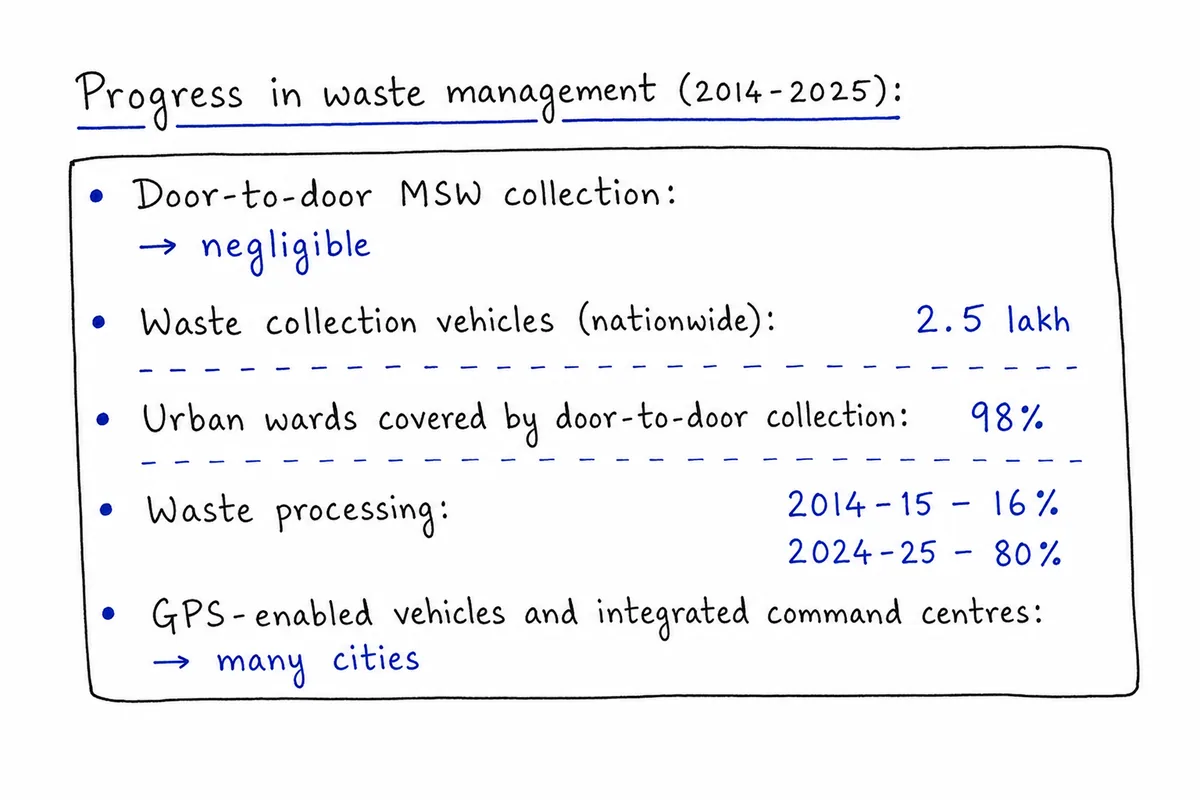
India's solid waste management is held back by unsegregated waste, legacy dumpsites and weak urban local bodies, despite the SWM Rules, 2016 and Swachh Bharat Mission-Urban 2.0. Indore's six-way segregation and bio-CNG plant succeeded where Delhi's overflowing Ghazipur, Bhalswa and Okhla landfills failed.
Model answer
Ghissu Editorial · Verified 4 Oct 2026 · 290 words
Mixed waste
Poor segregation at source leaves wet waste that defeats composting and waste-to-energy plants.
Legacy dumpsites
About 2,479 dumpsites hold nearly 25 crore tonnes of old waste (PIB, 2026).
Weak urban local bodies
A 2025 CAG audit found only 3 of 45 test-checked Uttar Pradesh ULBs had SWM plans.
Rules
The Solid Waste Management Rules, 2016 mandate three-way segregation, user fees and bulk-generator duties, while the Plastic Waste Management Rules add Extended Producer Responsibility and the 2022 single-use plastic ban.
Missions
Swachh Bharat Mission-Urban 2.0 (2021) targets Garbage Free Cities, ranked through Swachh Survekshan star ratings.
Dumpsite remediation
The Lakshya Zero Dumpsite drive has remediated over 61% of legacy waste (PIB, 2026).
Delhi's landfill failure
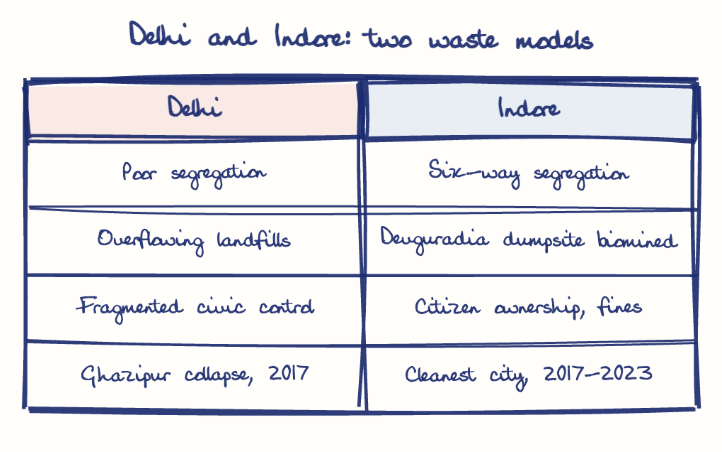
Ghazipur, Bhalswa and Okhla landfills are far beyond capacity, and a Ghazipur slope collapse killed two people in 2017, reflecting poor segregation and fragmented civic control.
Indore's segregation model
Door-to-door collection with six-way segregation, GPS-tracked vehicles and fines made Indore India's cleanest city in Swachh Survekshan every year from 2017 to 2023.
Indore's closed loop
Its 550-tonne-a-day bio-CNG plant (2022) fuels city buses, and biomining cleared its Devguradia dumpsite.
This model answer is indicative and the model can make mistakes; please verify key facts independently.
Practise this question
1Get the answer sheet
Sized for this question.
2Write your answer
Timed, by hand.
3Get it marked
Your score and what to fix.
This chapter in the exam
Environmental Pollution and Degradation13 questions
Asked in 11 of 14 sittings since 2013
- 2025Examine the factors responsible for depleting groundwater in India. What are the steps taken by the government to mitigate such depletion of groundwater ?
- 2025Mineral resources are fundamental to the country's economy and these are exploited by mining. Why is mining considered an environmental hazard ? Explain the remedial measures required to reduce the environmental hazard due to mining.
All 13 questions, sorted by sub-topic, with model answers and practice.
Question from the official UPSC Civil Services (Main) Examination 2026 paper. Answer written by Ghissu's engine and checked against our editorial standards. Found an error? Tell us and we correct it within 48 hours.