2019 · GS Paper 3 · Q17 · 15 marks
Define the concept of carrying capacity of an ecosystem as relevant to an environment. Explain how understanding this concept is vital while planning for sustainable development of a region.
In short
Carrying capacity is the maximum population or human activity an ecosystem can sustain indefinitely without degrading its resources, and planning within it keeps regional development sustainable. Joshimath's subsidence in 2023, decades after the M.C. Mishra Committee's 1976 warning, shows the cost of ignoring it.
Model answer
Ghissu Editorial · Verified 4 Oct 2026 · 300 words
Definition
Carrying capacity (K) is the maximum population of a species, or level of human activity, that an ecosystem can sustain indefinitely without degrading its food, water, habitat and capacity to absorb waste.
Logistic limit
In the Verhulst logistic model growth levels off at K, and a population that overshoots it usually crashes.
Human dimensions
For people the limit shifts with technology and consumption, as the IPAT identity of Ehrlich and Holdren shows, and it spans physical, ecological, infrastructural and social capacity.
Fragile Himalayan towns
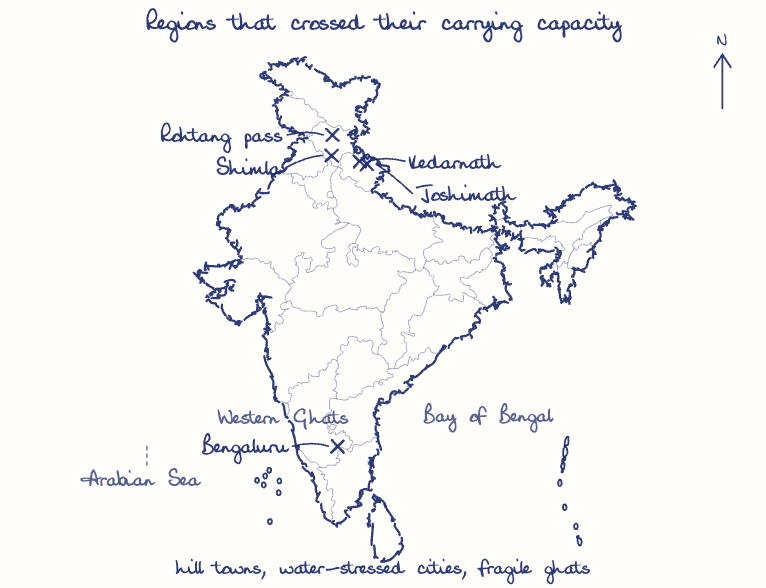
In 2023 the Supreme Court asked the Centre to assess the carrying capacity of Himalayan hill towns, after Joshimath and the 2013 Kedarnath floods.
Water as the binding limit
The Dynamic Groundwater Resources Assessment 2025 lists 730 of 6,762 units as over-exploited, so urban growth must be sized to recharge.
Zoning and tourism ceilings
The Gadgil (2011) and Kasturirangan (2013) reports graded the Western Ghats by sensitivity, and the NGT froze new construction in Shimla's core and green areas in 2017.
Capacity-based plans
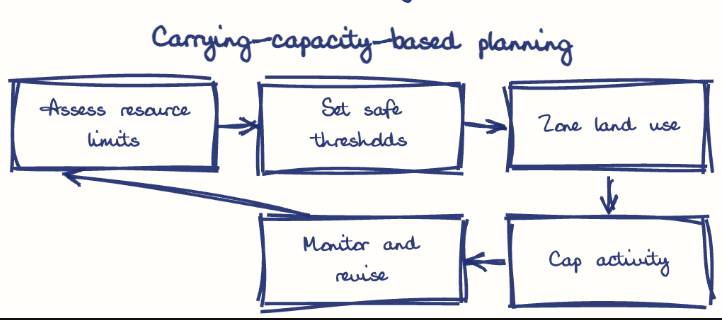
Every master plan in an eco-sensitive region should rest on a carrying capacity study and a cumulative, valley-wide impact assessment rather than project-by-project clearance.
This model answer is indicative and the model can make mistakes; please verify key facts independently.
Practise this question
1Get the answer sheet
Sized for this question.
2Write your answer
Timed, by hand.
3Get it marked
Your score and what to fix.
This chapter in the exam
Conservation19 questions
Asked in 11 of 14 sittings since 2013
- 2026Discuss the aim and goals of Kunming-Montreal global biodiversity framework. Mention India's commitments and initiatives to achieve the goals and targets of this framework giving suitable examples. (Answer in 150 words)
- 2025What is Carbon Capture, Utilization and Storage (CCUS) ? What is the potential role of CCUS in tackling climate change ?
All 19 questions, sorted by sub-topic, with model answers and practice.
Question from the official UPSC Civil Services (Main) Examination 2019 paper. Answer written by Ghissu's engine and checked against our editorial standards. Found an error? Tell us and we correct it within 48 hours.