2019 · GS Paper 3 · Q2 · 10 marks
Do you agree with the view that steady GDP growth and low inflation have left the Indian economy in good shape? Give reasons in support of your arguments.
In short
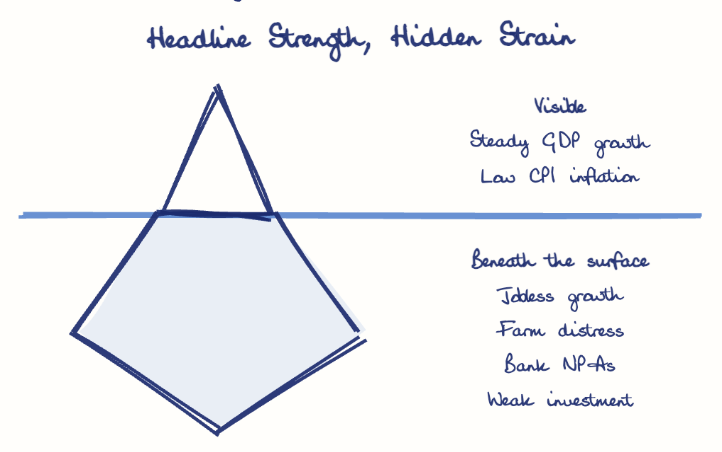
Steady growth and low inflation gave India macroeconomic stability in 2018-19, but they masked weak demand, jobless growth, farm distress and balance-sheet stress. GDP grew 6.8% with CPI inflation at 3.4%, yet growth slipped to 5% by April-June 2019.
Model answer
Ghissu Editorial · Verified 4 Oct 2026 · 272 words
Macro stability
The current account deficit near 2.1% of GDP, reserves above $400 billion and a fiscal deficit of about 3.4% of GDP in 2018-19 limited external and fiscal risk.
Credible institutions
Inflation targeting under the amended RBI Act (2016) anchored expectations, while GST (2017) and the Insolvency and Bankruptcy Code (2016) improved formalisation and credit discipline.
Business climate
India rose to 63rd in the World Bank's Doing Business 2020 from 142nd in 2014.
Slowing demand
Passenger vehicle sales saw their steepest fall in about two decades in 2019, and growth fell for five straight quarters.
Jobless growth
PLFS 2017-18 put unemployment at 6.1%, widely reported as a 45-year high.
Low inflation as a symptom
Food inflation close to zero in 2018-19 squeezed farm incomes and rural demand.
Financial stress
Bank gross NPAs peaked at 11.2% in March 2018 and the IL&FS default of September 2018 froze NBFC credit, keeping private investment weak.
This model answer is indicative and the model can make mistakes; please verify key facts independently.
Practise this question
1Get the answer sheet
Sized for this question.
2Write your answer
Timed, by hand.
3Get it marked
Your score and what to fix.
This chapter in the exam
Growth8 questions
Asked in 6 of 14 sittings since 2013
- 2024Discuss the merits and demerits of the four 'Labour Codes' in the context of labour market reforms in India. What has been the progress so far in this regard?
- 2024What are the causes of persistent high food inflation in India? Comment on the effectiveness of the monetary policy of the RBI to control this type of inflation.
All 8 questions, sorted by sub-topic, with model answers and practice.
Question from the official UPSC Civil Services (Main) Examination 2019 paper. Answer written by Ghissu's engine and checked against our editorial standards. Found an error? Tell us and we correct it within 48 hours.