2019 · GS Paper 3 · Q1 · 10 marks
Enumerate the indirect taxes which have been subsumed in the Goods and Services Tax (GST) in India. Also, comment on the revenue implications of the GST introduced in India since July 2017.
In short
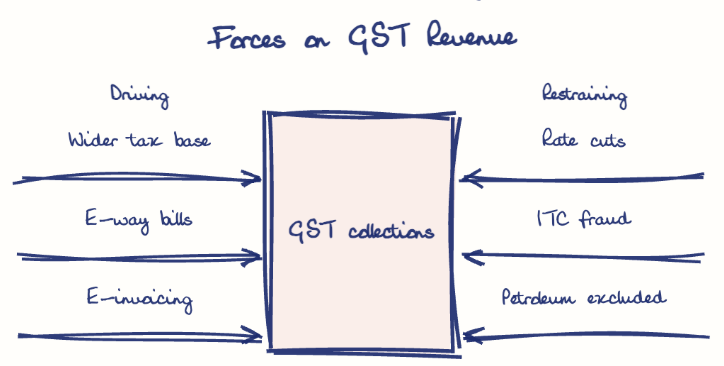
GST subsumed central excise, service tax, CVD, SAD and central cesses along with state VAT, CST, entry, entertainment, luxury and purchase taxes, octroi and state cesses. Revenue first lagged because of rate cuts below the revenue-neutral rate, then rose to a record Rs 22.08 lakh crore in 2024-25.
Model answer
Ghissu Editorial · Verified 4 Oct 2026 · 275 words
Central levies
Central excise and additional excise duties, excise under the Medicinal and Toilet Preparations Act, service tax, CVD, SAD, and central cesses and surcharges.
State levies
VAT or sales tax, CST, purchase tax, luxury tax, entry tax and octroi, entertainment tax (except by local bodies), advertisement tax, taxes on lottery, betting and gambling, and state cesses.
Kept outside
Basic customs duty, stamp duty, electricity duty, alcohol and five petroleum products.
Base widening
Registrations rose from about 60 lakh in 2017 to 1.51 crore by April 2025 (GST Council), and e-way bills curbed evasion in goods movement.
Below revenue neutrality
Rate cuts, such as 178 items moved from 28% to 18% in 2017, kept the effective rate below the Subramanian Committee's 15 to 15.5%.
States' dependence
Having surrendered most own indirect taxes, states relied on compensation guaranteeing 14% annual growth, and its delays in 2019 and 2020 caused federal friction.
Rising buoyancy
Collections grew from Rs 11.37 lakh crore in 2020-21 to Rs 22.08 lakh crore in 2024-25 (PIB, 2025).
This model answer is indicative and the model can make mistakes; please verify key facts independently.
Practise this question
1Get the answer sheet
Sized for this question.
2Write your answer
Timed, by hand.
3Get it marked
Your score and what to fix.
This chapter in the exam
Fiscal Federalism4 questions
Asked in 4 of 14 sittings since 2013
- 2025Explain how the Fiscal Health Index (FHI) can be used as a tool for assessing the fiscal performance of states in India. In what way would it encourage the states to adopt prudent and sustainable fiscal policies ?
- 2020Explain the rationale behind the Goods and Services Tax (Compensation to States) Act of 2017. How has COVID-19 impacted the GST compensation fund and created new federal tensions?
All 4 questions, sorted by sub-topic, with model answers and practice.
Question from the official UPSC Civil Services (Main) Examination 2019 paper. Answer written by Ghissu's engine and checked against our editorial standards. Found an error? Tell us and we correct it within 48 hours.