2019 · GS Paper 3 · Q3 · 10 marks
How far is Integrated Farming System (IFS) helpful in sustaining agricultural production?
In short
IFS sustains agricultural production to a large extent by recycling nutrients, spreading risk across crops, livestock and fish, and raising output per acre, though capital, skill, scale and market gaps limit its reach. Livestock GVA rose about 195% between FY15 and FY24.
Model answer
Ghissu Editorial · Verified 4 Oct 2026 · 275 words
Cheaper, healthier soil
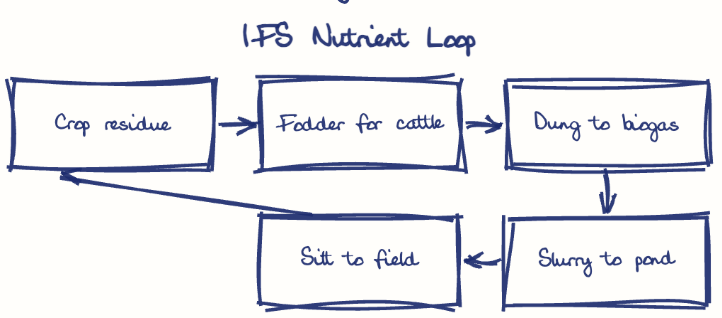
The loop replaces part of the chemical fertiliser bill and rebuilds soil organic carbon, so yields hold at lower cost.
Risk spread
Milk, eggs and fish keep earning when the crop fails; livestock GVA rose about 195% at current prices between FY15 and FY24 (Department of Animal Husbandry and Dairying).
More from each acre
Apatani rice-fish terraces in Ziro, Arunachal Pradesh, and Kuttanad's rice-fish-duck farms harvest several products from the same water, while NMSA's Rainfed Area Development component promotes IFS for climate resilience.
Capital and skill
Ponds, sheds and biogas units need credit and extension that marginal farmers rarely get, so ICAR's Indian Institute of Farming Systems Research, Modipuram, designs zone-specific models.
Scale and markets
Fragmented plots and dry regions leave little room for ponds or fodder, and milk and fish lack the cold chains and assured buyers that MSP gives grain.
This model answer is indicative and the model can make mistakes; please verify key facts independently.
Practise this question
1Get the answer sheet
Sized for this question.
2Write your answer
Timed, by hand.
3Get it marked
Your score and what to fix.
This chapter in the exam
Major Crops and Cropping Patterns10 questions
Asked in 10 of 14 sittings since 2013
- 2026How Indian agriculture has been transformed from food scarcity to food surplus level? Explain the various government policies implemented for diversification of Indian agriculture. (Answer in 250 words)
- 2025Explain the factors influencing the decision of the farmers on the selection of high value crops in India.
All 10 questions, sorted by sub-topic, with model answers and practice.
Question from the official UPSC Civil Services (Main) Examination 2019 paper. Answer written by Ghissu's engine and checked against our editorial standards. Found an error? Tell us and we correct it within 48 hours.