2019 · GS Paper 4 · Q2(b) · 10 marks
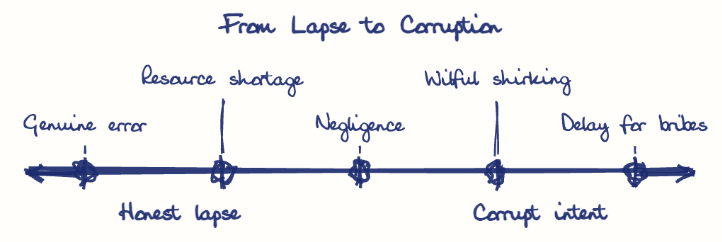
"Non-performance of duty by a public servant is a form of corruption". Do you agree with this view? Justify your answer.
In short
Wilful non-performance of duty is a form of corruption, since it abuses entrusted public power for private ease or gain, but genuine incapacity is not. About a quarter of government primary teachers were found absent on unannounced visits in a 2005 study.
Model answer
Ghissu Editorial · Verified 4 Oct 2026 · 281 words
Pay without work
About a quarter of government primary teachers were absent on unannounced visits (Kremer, Muralidharan and others, 2005), costing about $1.5 billion a year by a 2017 estimate.
Delay as a lever
The Santhanam Committee (1964) named delay a chief cause of corruption, since an untouched file becomes the price of "speed money".
Collusion by omission
An inspector who does not inspect sells safety by silence; the Morbi bridge collapse (2022), which killed 135 people, followed lapses in oversight of the repair contract.
Law links them
The CCS (Conduct) Rules demand "devotion to duty", and FR 56(j) retires officers of doubtful integrity or effectiveness.
Incapacity is not intent
Vacant posts, heavy caseloads and poor equipment cause lapses without mala fides, and the label punishes the system's victims.
Fear breeds paralysis
Honest officers already fear the CBI, CVC, CAG and courts, and Section 17A (2018) was added partly to shield bona fide decisions; branding every inaction corrupt deepens risk aversion among honest officers.
This model answer is indicative and the model can make mistakes; please verify key facts independently.
Practise this question
1Get the answer sheet
Sized for this question.
2Write your answer
Timed, by hand.
3Get it marked
Your score and what to fix.
This chapter in the exam
Challenges of corruption6 questions
Asked in 5 of 14 sittings since 2013
- 2022Whistle-blower, who reports corruption and illegal activities, wrongdoing and misconduct to the concerned authorities, runs the risk of being exposed to grave danger, physical harm and victimization by the vested interests, accused persons and his team. What policy measures would you suggest to strengthen protection mechanism to safeguard the whistle-blower?
- 2016"Corruption causes misuse of government treasury, administrative inefficiency and obstruction in the path of national development." Discuss Kautilya's views.
All 6 questions, sorted by sub-topic, with model answers and practice.
Question from the official UPSC Civil Services (Main) Examination 2019 paper. Answer written by Ghissu's engine and checked against our editorial standards. Found an error? Tell us and we correct it within 48 hours.