2019 · GS Paper 4 · Q4(b) · 10 marks
There is a view that the Official Secrets Act is an obstacle to the implementation of Right to Information Act. Do you agree with the view? Discuss.
In short
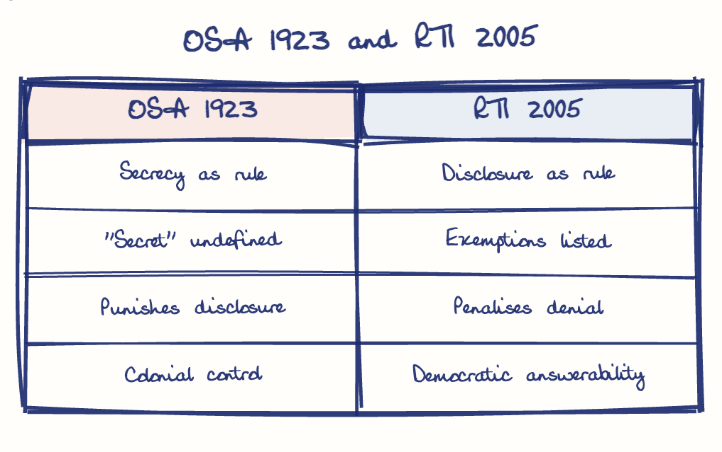
The Official Secrets Act obstructs RTI in practice through its undefined notion of secrecy and the culture of withholding it sustains, but in law the RTI Act prevails through Sections 22 and 8(2). The Second ARC (2006) recommended repealing OSA and moving genuine secrets into the National Security Act.
Model answer
Ghissu Editorial · Verified 4 Oct 2026 · 288 words
Undefined "secret"
Section 5 punishes communication of official information without defining secrecy, so almost any file can be withheld.
Culture of secrecy
With Rule 11 of the CCS (Conduct) Rules, 1964, it trains officers to withhold first, making Public Information Officers wary of disclosure.
Chilling effect
The case against journalist Iftikhar Gilani (2002), dropped because the material was public, and OSA threats over the Rafale papers (2019) deter the press and whistleblowers.
Expert verdict
The Second ARC (2006) recommended repealing OSA and moving genuine secrets into the National Security Act.
Overriding clause
Section 22 gives RTI effect notwithstanding OSA, and Section 8(2) permits disclosure when public interest outweighs harm.
Courts side with RTI
In Yashwant Sinha v CBI (2019) the Supreme Court relied on these provisions to admit the Rafale documents.
Security protected
Section 8(1)(a) and Section 24 shield security, yet keep allegations of corruption and human rights violations open.
This model answer is indicative and the model can make mistakes; please verify key facts independently.
Practise this question
1Get the answer sheet
Sized for this question.
2Write your answer
Timed, by hand.
3Get it marked
Your score and what to fix.
This chapter in the exam
Information sharing and transparency in government; Right to Information4 questions
Asked in 4 of 14 sittings since 2013
- 2018"The Right to Information Act is not all about citizens' empowerment alone, it essentially redefines the concept of accountability." Discuss.
- 2017Examine the relevance of the following in the context of civil service: Transparency
All 4 questions, sorted by sub-topic, with model answers and practice.
Question from the official UPSC Civil Services (Main) Examination 2019 paper. Answer written by Ghissu's engine and checked against our editorial standards. Found an error? Tell us and we correct it within 48 hours.