2019 · GS Paper 4 · Q3(b) · 10 marks
What is meant by 'crisis of conscience'? How does it manifest itself in the public domain?
In short
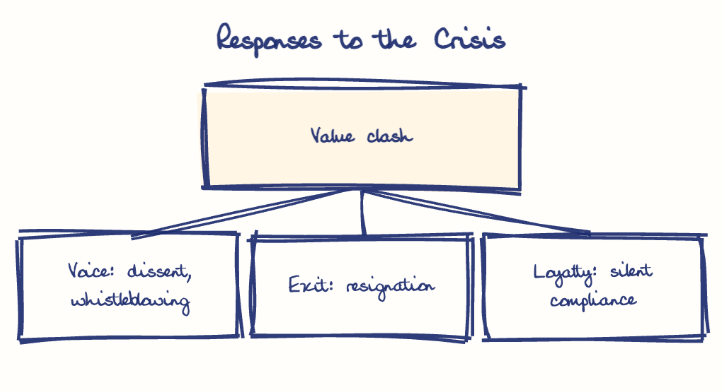
A crisis of conscience is the inner turmoil when the demands of a role or superior collide with one's own moral sense. In public life it shows as voice, exit or silent loyalty, as in Satyendra Dubey's whistleblowing (2003) and Kannan Gopinathan's resignation (2019).
Model answer
Ghissu Editorial · Verified 4 Oct 2026 · 272 words
Clash of two goods
It is a conflict between competing duties, such as loyalty to the organisation and honesty to the public, so every option carries a moral cost.
Inner moral distress
It shows as guilt, anxiety and self-doubt.
Distinct from temptation
Wanting a bribe is temptation; being ordered to do a lawful but unjust act is a crisis of conscience.
Voice through whistleblowing
NHAI engineer Satyendra Dubey exposed corruption in the Golden Quadrilateral project and was murdered in 2003, leading to the PIDPI Resolution of 2004 and the Whistle Blowers Protection Act, 2014.
Voice through dissent
Justice H.R. Khanna's lone dissent in ADM Jabalpur (1976) cost him the Chief Justiceship.
Exit through resignation
IAS officer Kannan Gopinathan resigned in 2019 over curbs on expression in Jammu and Kashmir.
Loyalty with distress
Many officials comply silently, which can harden into cynicism; a reasoned dissent note on file is the lawful middle path.
This model answer is indicative and the model can make mistakes; please verify key facts independently.
Practise this question
1Get the answer sheet
Sized for this question.
2Write your answer
Timed, by hand.
3Get it marked
Your score and what to fix.
This chapter in the exam
Laws, rules, regulations and conscience as sources of ethical guidance16 questions
Asked in 9 of 14 sittings since 2013
- 2026Dr. B. R. Ambedkar had cautioned that employing civil disobedience within a constitutional democracy equates to endorsing 'anarchy'. How should modern democracies navigate the ethical dilemmas posed by civil disobedience movements that aim to promote social justice against policies that may raise genuine concerns?
- 2026Usually schools, working in remote areas, do not fully comply with government regulations. However, if the rules are enforced strictly, it would lead to most schools closing down. How should an administrator strike a balance between enforcement of rules and educational rights of children?
All 16 questions, sorted by sub-topic, with model answers and practice.
Question from the official UPSC Civil Services (Main) Examination 2019 paper. Answer written by Ghissu's engine and checked against our editorial standards. Found an error? Tell us and we correct it within 48 hours.