2020 · GS Paper 1 · Q9 · 10 marks
COVID-19 pandemic accelerated class inequalities and poverty in India. Comment.
In short
COVID-19 widened class inequality in India more durably than it raised poverty, because informal workers lost incomes while wealth at the top grew and welfare only cushioned the fall. State of Working India 2021 found about 230 million people fell below the Rs 375 daily minimum wage threshold.
Model answer
Ghissu Editorial · Verified 4 Oct 2026 · 288 words
The 2020 lockdown struck an economy in which about nine in ten workers are informal, so the shock fell hardest on those without savings or digital access. Pew Research Center (2021) estimated that Indians living on $2 a day or less rose by about 75 million in 2020.
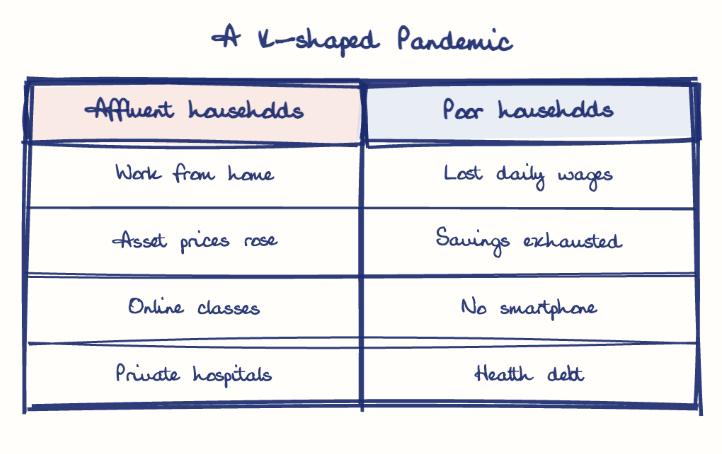
How the Pandemic Deepened Poverty and Class Gaps
A K-shaped Pandemic a: Affluent households b: Poor households → Work from home :: Lost daily wages → Asset prices rose :: Savings exhausted → Online classes :: No smartphone → Private hospitals :: Health debt
1. Income collapse: State of Working India 2021 (Azim Premji University) found about 230 million people fell below the Rs 375 daily minimum wage threshold in the first wave. 2. Migrant exodus: Over one crore migrant workers returned home in 2020, exposing labour with no portable rations or social security. 3. Wealth at the top: Oxfam's Inequality Kills (2022) reported India's billionaires rose from 102 to 142 in 2021 while most households lost income. 4. Gender and learning gaps: Women lost work permanently more often than men, and children without smartphones fell out of online schooling.
Food and work buffers
PM Garib Kalyan Anna Yojana fed about 80 crore people, and MGNREGA's record 2020-21 allocation of over Rs 1.1 lakh crore absorbed returning migrants.
Spike later reversed
The World Bank estimates 171 million Indians left extreme poverty between 2011-12 and 2022-23, so the 2020 spike did not undo the longer decline.
This model answer is indicative and the model can make mistakes; please verify key facts independently.
Practise this question
1Get the answer sheet
Sized for this question.
2Write your answer
Timed, by hand.
3Get it marked
Your score and what to fix.
This chapter in the exam
Poverty and developmental issues9 questions
Asked in 6 of 14 sittings since 2013
- 2025Achieving sustainable growth with emphasis on environmental protection could come into conflict with poor people's needs in a country like India - Comment.
- 2025How does smart city in India, address the issues of urban poverty and distributive justice ?
All 9 questions, sorted by sub-topic, with model answers and practice.
Question from the official UPSC Civil Services (Main) Examination 2020 paper. Answer written by Ghissu's engine and checked against our editorial standards. Found an error? Tell us and we correct it within 48 hours.