2020 · GS Paper 1 · Q3 · 10 marks
Evaluate the policies of Lord Curzon and their long term implications on the national movements.
In short
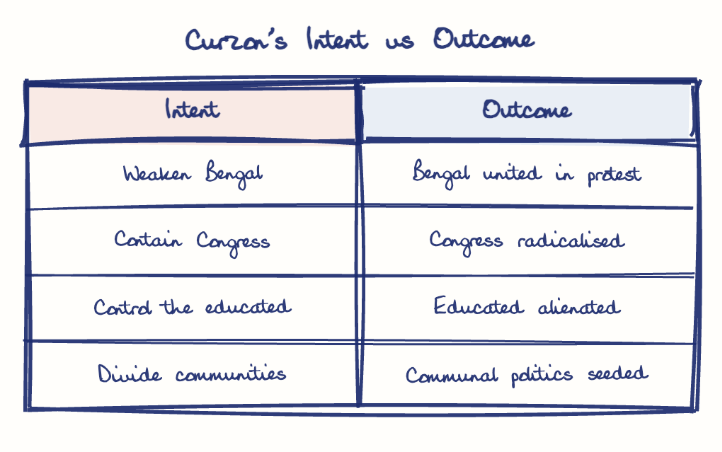
Curzon's efficiency-driven but centralising policies, above all the 1905 partition of Bengal, backfired by radicalising Indian nationalism. The Swadeshi movement, the Surat split, revolutionary groups and the Muslim League's founding in 1906 followed, though his Ancient Monuments Preservation Act (1904) was a lasting gain.
Model answer
Ghissu Editorial · Verified 4 Oct 2026 · 290 words
Curbs on self-government
The Calcutta Corporation Act (1899) cut elected members and the Official Secrets Act (1904) restricted the press.
Control of universities
The Indian Universities Act (1904), after the Raleigh Commission, tightened official control and alienated the educated middle class.
Partition of Bengal
Effected in October 1905, it was seen by Risley as a way to divide a united, politically conscious Bengal.
Constructive reforms
The Ancient Monuments Preservation Act (1904), the Pusa research institute and the Police Commission (1902) were lasting gains.
Swadeshi as rehearsal
Boycott, national education and swadeshi enterprise became techniques Gandhi later scaled up.
Extremism and revolution
The swaraj goal (1906), the Surat split (1907) and groups such as the Anushilan Samiti followed as Tilak and Aurobindo gained ground.
Communal politics
The Muslim League (Dacca, 1906) and separate electorates (1909) seeded religious politics that ran on to 1947.
Confidence of victory
The annulment of 1911 showed that agitation could reverse imperial decisions.
This model answer is indicative and the model can make mistakes; please verify key facts independently.
Practise this question
1Get the answer sheet
Sized for this question.
2Write your answer
Timed, by hand.
3Get it marked
Your score and what to fix.
This chapter in the exam
Role of Masses and Personalities13 questions
Asked in 8 of 14 sittings since 2013
- 2026The significance of the Gandhian movements lay in the masses they mobilized. Elucidate.
- 2021Bring out the constructive programmes of Mahatma Gandhi during Non-Cooperation Movement and Civil Disobedience Movement.
All 13 questions, sorted by sub-topic, with model answers and practice.
Question from the official UPSC Civil Services (Main) Examination 2020 paper. Answer written by Ghissu's engine and checked against our editorial standards. Found an error? Tell us and we correct it within 48 hours.