2020 · GS Paper 1 · Q11 · 15 marks
Indian Philosophy and tradition played a significant role in conceiving and shaping the monuments and their art in India. Discuss.
In short
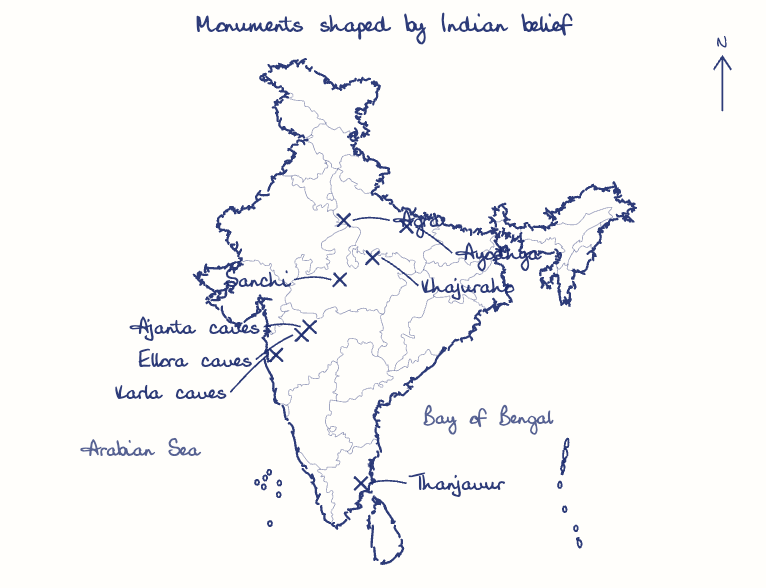
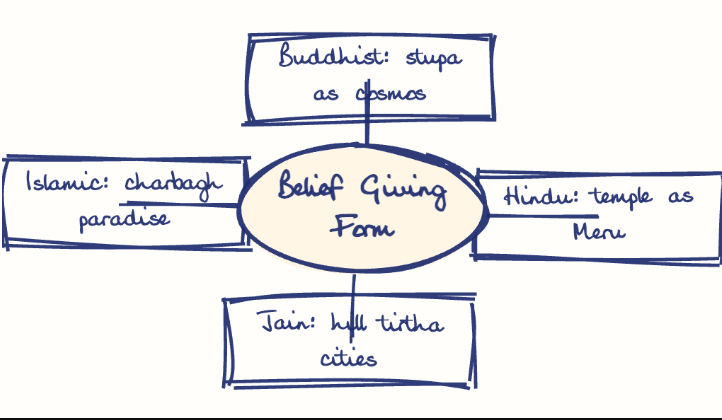
Indian philosophy conceived the forms of monuments, the stupa as a model of the cosmos, the temple as Mount Meru on the Vastu Purusha Mandala, the charbagh as paradise, and shaped their art from Ajanta's Padmapani to the Chola Nataraja. Patronage and trade set their scale and style alongside belief.
Model answer
Ghissu Editorial · Verified 4 Oct 2026 · 272 words
Stella Kramrisch's The Hindu Temple (1946) read the temple as a model of the cosmos. From the Barabar caves to the Taj Mahal, belief decided both the form of Indian monuments and the art that covers them, and the Shilpa Shastra canon still shaped Ayodhya's Ram temple in 2024.
Philosophy Conceiving the Monuments
FIGURE: history-p11-1 | Sanchi stupa: anda, harmika, chhatra, vedika, toranas and pradakshina path
1. Stupa as cosmos: The anda is the dome of heaven over the relic, the chhatra marks the world axis, and the pradakshina path makes worship a walk around the Buddha. 2. Ascetic retreats: The Barabar caves, gifted to the Ajivikas, and the chaityas of Karla and Ajanta met the sramana need for lasting shelters. 3. Temple as Meru: Built on the Vastu Purusha Mandala, the temple's garbhagriha is the deity's womb-house and its shikhara the cosmic mountain. 4. Indo-Islamic ideas: The paradise garden gave the charbagh of the Taj, and aniconism turned ornament to calligraphy.
Compassion and theology
Ajanta's Padmapani paints Mahayana compassion, and the Chola Nataraja turns Shaiva cosmology into bronze.
Renunciation
The Gommateshwara at Shravanabelagola (c. 983 CE) stands in the kayotsarga posture of Jain austerity.
Not philosophy alone
Rajaraja I's ambition, the Vidisha ivory carvers at Sanchi and Gandhara's Greco-Roman style show patronage and trade shaping scale and style.
Interpret and conserve
Site museums should explain meanings, and Ajanta's murals need climate monitoring and replica galleries.
This model answer is indicative and the model can make mistakes; please verify key facts independently.
Practise this question
1Get the answer sheet
Sized for this question.
2Write your answer
Timed, by hand.
3Get it marked
Your score and what to fix.
This chapter in the exam
Art Forms10 questions
Asked in 8 of 14 sittings since 2013
- 2025The sculptors filled the Chandella artform with resilient vigor and breadth of life.' Elucidate.
- 2022Discuss the significance of the lion and bull figures in Indian mythology, art and architecture.
All 10 questions, sorted by sub-topic, with model answers and practice.
Question from the official UPSC Civil Services (Main) Examination 2020 paper. Answer written by Ghissu's engine and checked against our editorial standards. Found an error? Tell us and we correct it within 48 hours.