2020 · GS Paper 1 · Q2 · 10 marks
Pala period is the most significant phase in the history of Buddhism in India. Enumerate.
In short
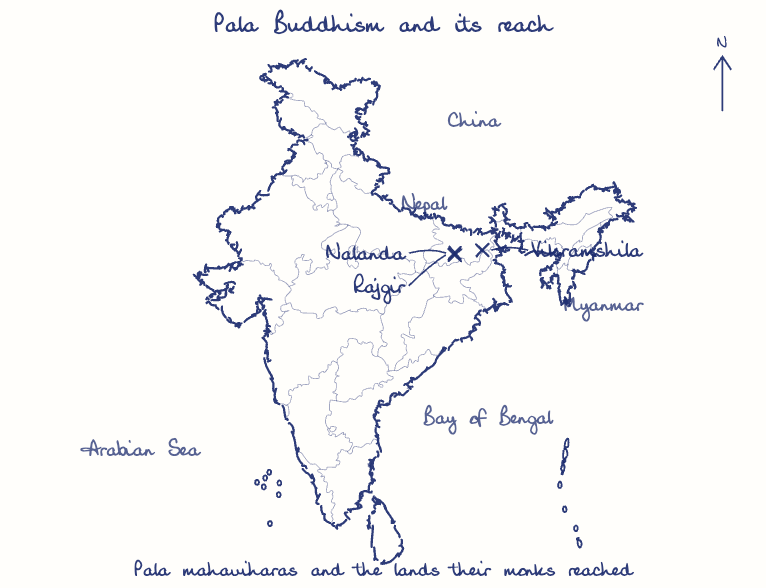
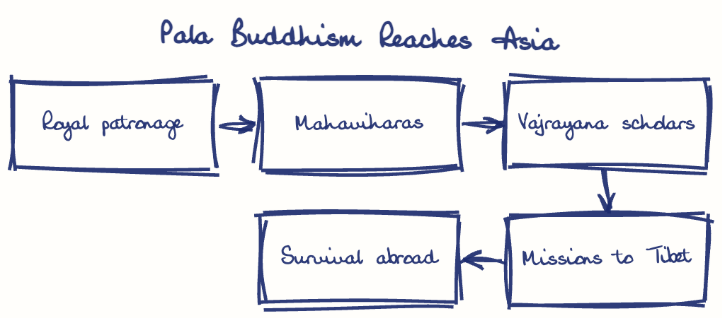
The Pala period (c. 750 to 1160s CE) was Buddhism's last great Indian flowering, through royal mahaviharas, mature Vajrayana doctrine and a distinctive art. Atisha Dipankara of Vikramashila carried this tradition to Tibet around 1040 CE, so it survived abroad after Nalanda's ruin.
Model answer
Ghissu Editorial · Verified 4 Oct 2026 · 272 words
Mahavihara network
Dharmapala founded Vikramashila and Somapura at Paharpur (UNESCO site, 1985), which joined Odantapuri and later Jagaddala as monastic universities.
Nalanda sustained
Devapala's Nalanda copper plate records five villages granted for a monastery of the Sailendra king Balaputradeva, showing Nalanda's pan-Asian prestige.
Vajrayana and vernacular
Tantric Buddhism took systematic form here, and the Siddhacharyas' Charyapada songs became the earliest proto-Bengali, Assamese and Odia literature, carrying Buddhist ideas to ordinary listeners.
Pala school of art
Black stone images, the Kurkihar bronzes and illuminated Prajnaparamita manuscripts fixed the iconography of Tara and the Bodhisattvas, later echoed in Nepal, Tibet and Pagan.
Second diffusion in Tibet
Atisha Dipankara of Vikramashila reached Tibet around 1040 CE and inspired the Kadam school, seeding Tibet's later monastic tradition.
Bridge before the fall
After Bakhtiyar Khalji's raids around 1200 CE ruined Nalanda and Vikramashila, the Pala texts and teachers preserved in Nepal and Tibet kept the tradition alive.
This model answer is indicative and the model can make mistakes; please verify key facts independently.
Practise this question
1Get the answer sheet
Sized for this question.
2Write your answer
Timed, by hand.
3Get it marked
Your score and what to fix.
This chapter in the exam
Indian Culture - Ancient Times8 questions
Asked in 6 of 14 sittings since 2013
- 2026Analyze the importance of Ashokan inscriptions for reconstructing Mauryan history.
- 2024Underline the changes in the field of society and economy from the Rig Vedic to the later Vedic period.
All 8 questions, sorted by sub-topic, with model answers and practice.
Question from the official UPSC Civil Services (Main) Examination 2020 paper. Answer written by Ghissu's engine and checked against our editorial standards. Found an error? Tell us and we correct it within 48 hours.