2020 · GS Paper 1 · Q1 · 10 marks
The rock-cut architecture represents one of the most important sources of our knowledge of early Indian art and history. Discuss.
In short
Rock-cut monuments are among the most important sources of early Indian art and history because they preserve painting, sculpture, inscriptions and engineering almost intact. Ashoka's Barabar caves, Ajanta's murals, Kharavela's Hathigumpha inscription and Ellora's Kailasa temple together trace a thousand years of religion, politics and trade.
Model answer
Ghissu Editorial · Verified 4 Oct 2026 · 296 words
Evolution of architecture
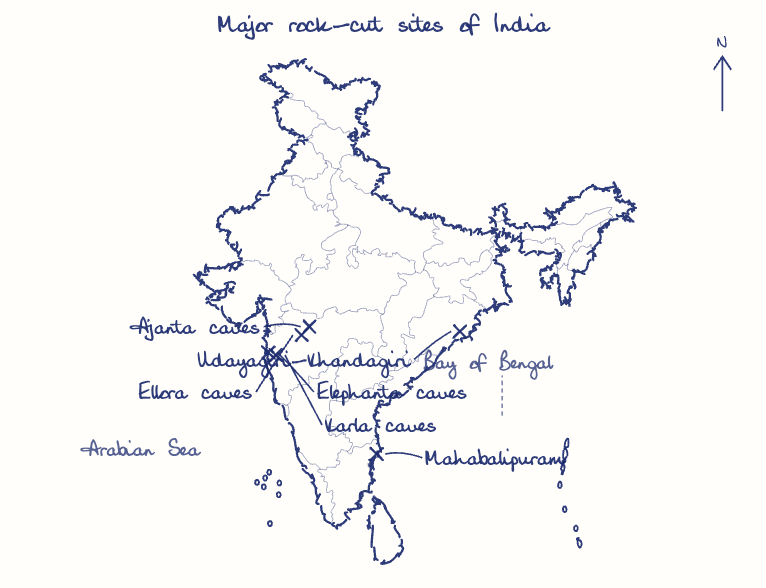
The Lomas Rishi cave's horseshoe-arched facade copies wooden huts in stone, and the chaityas of Bhaja and Karle trace timber forms turning into stone.
Painting and sculpture
Ajanta's Padmapani mural and Elephanta's Maheshmurti show classical painting and Hindu iconography at their peak.
Engineering skill
The Rashtrakuta Kailasa temple was carved top-down from a single rock.
Religion and tolerance
Barabar's Ashokan inscriptions record gifts to the Ajivikas, and Ellora's 34 Buddhist, Hindu and Jain caves stand side by side.
Political history
Kharavela's Hathigumpha inscription and Gautami Balashri's Nashik inscription are primary sources for Kalinga and Satavahana rule.
Economy and society
Karle's donor inscriptions name merchants and Yavanas, revealing foreign contact and lay patronage, while Ajanta's murals depict dress and court life.
Limits of the source
Caves mirror royal and monastic patrons, not ordinary people, and many are dated only by style, so they must be read with texts and coins.
This model answer is indicative and the model can make mistakes; please verify key facts independently.
Practise this question
1Get the answer sheet
Sized for this question.
2Write your answer
Timed, by hand.
3Get it marked
Your score and what to fix.
This chapter in the exam
Architecture8 questions
Asked in 8 of 14 sittings since 2013
- 2026Vijayanagara architecture exemplifies the amalgamation of past traditions with contemporary practices. Elucidate with examples.
- 2025Discuss the salient features of the Harappan architecture.
All 8 questions, sorted by sub-topic, with model answers and practice.
Question from the official UPSC Civil Services (Main) Examination 2020 paper. Answer written by Ghissu's engine and checked against our editorial standards. Found an error? Tell us and we correct it within 48 hours.