2020 · GS Paper 2 · Q9 · 10 marks
Critically examine the role of WHO in providing global health security during the Covid-19 pandemic.
In short
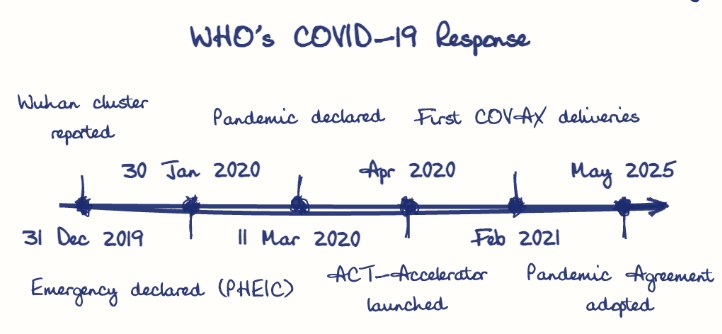
The WHO was indispensable during COVID-19 as a coordinator of science, guidance and vaccine equity, but it was too weak to enforce global health security. COVAX delivered nearly two billion doses, yet the WHO delayed its emergency alarm and lacked any power to compel states.
Model answer
Ghissu Editorial · Verified 4 Oct 2026 · 295 words
Guidance
It circulated the virus genome, testing protocols and clinical guidance that poorer health systems, lacking their own expert bodies, relied upon.
Science Coordination
Its multi-country Solidarity Trial showed remdesivir and hydroxychloroquine did little to cut mortality, saving scarce money.
Equity in Access
COVAX, with Gavi and CEPI, delivered nearly two billion doses, and Emergency Use Listing cleared Covishield and Covaxin.
Delayed Alarm
Its Emergency Committee declined to declare an emergency in late January 2020, and early statements leaned on China's assurances.
Shifting Advice
Public masking was advised only in June 2020, and airborne spread was accepted late.
No Enforcement Power
The IHR let the WHO advise but not compel, so states withheld data and defied travel advice.
Funding and Politics
Assessed contributions form under a fifth of its budget, the US announced withdrawal in 2020, and by April 2021 low-income countries had received only about 0.2% of doses.
This model answer is indicative and the model can make mistakes; please verify key facts independently.
Practise this question
1Get the answer sheet
Sized for this question.
2Write your answer
Timed, by hand.
3Get it marked
Your score and what to fix.
This chapter in the exam
Health6 questions
Asked in 5 of 14 sittings since 2013
- 2024In a crucial domain like the public healthcare system the Indian State should play a vital role to contain the adverse impact of marketisation of the system. Suggest some measures through which the State can enhance the reach of public healthcare at the grassroots level.
- 2021"Besides being a moral imperative of a Welfare State, primary health structure is a necessary precondition for sustainable development." Analyze.
All 6 questions, sorted by sub-topic, with model answers and practice.
Question from the official UPSC Civil Services (Main) Examination 2020 paper. Answer written by Ghissu's engine and checked against our editorial standards. Found an error? Tell us and we correct it within 48 hours.