2020 · GS Paper 2 · Q7 · 10 marks
Institutional quality is a crucial driver of economic performance. In this context suggest reforms in Civil Service for strengthening democracy.
In short
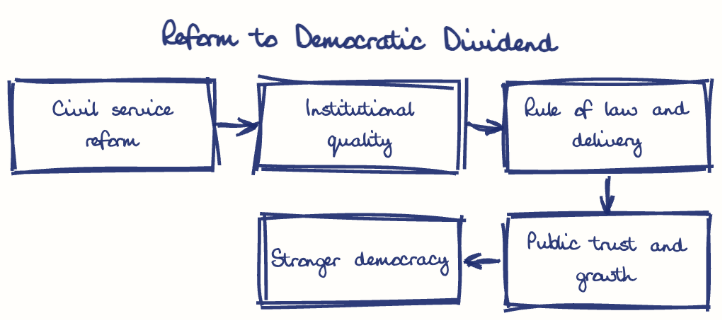
Strengthening democracy through the civil service needs reforms in capacity, merit, autonomy and accountability, since institutional quality drives economic performance. Key measures are Mission Karmayogi, mid-career domain assignment, calibrated lateral entry and the Civil Services Boards and minimum tenures directed in T.S.R. Subramanian (2013).
Model answer
Ghissu Editorial · Verified 4 Oct 2026 · 273 words
Competency-based training
Mission Karmayogi (2020) and its iGOT platform should shift training from rules to roles, building data, technology and citizen-service skills.
Domain depth
The Second ARC (2008) recommended mid-career domain assignment so officers specialise while keeping field experience.
Calibrated lateral entry
Joint Secretary-level expert entry, begun in 2019, should run through a transparent UPSC process that respects reservation.
Performance over seniority
Multi-source 360-degree appraisal for empanelment and outcome targets should replace promotion by seniority alone.
Tenure and autonomy
T.S.R. Subramanian (2013) directed Civil Services Boards, minimum tenures and written orders from political superiors, curbing transfer pressure.
Citizen accountability
Right to Services laws, social audit and CPGRAMS make officials answerable to citizens, not only to superiors.
Ethics framework
A statutory code of ethics, urged by the Second ARC (2007), with Lokpal oversight would make integrity a rule rather than a personal virtue.
This model answer is indicative and the model can make mistakes; please verify key facts independently.
Practise this question
1Get the answer sheet
Sized for this question.
2Write your answer
Timed, by hand.
3Get it marked
Your score and what to fix.
This chapter in the exam
Role of Civil Services in a Democracy6 questions
Asked in 6 of 14 sittings since 2013
- 2026Analyse the advantages and limitations of the generalist structure of the Indian Civil Services in contemporary governance.
- 2024The Doctrine of Democratic Governance makes it necessary that the public perception of the integrity and commitment of civil servants becomes absolutely positive. Discuss.
All 6 questions, sorted by sub-topic, with model answers and practice.
Question from the official UPSC Civil Services (Main) Examination 2020 paper. Answer written by Ghissu's engine and checked against our editorial standards. Found an error? Tell us and we correct it within 48 hours.