2020 · GS Paper 2 · Q15 · 15 marks
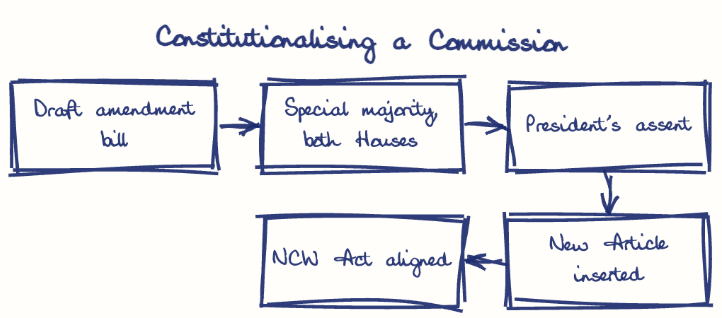
Which steps are required for constitutionalization of a Commission ? Do you think imparting constitutionality to the National Commission for Women would ensure greater gender justice and empowerment in India ? Give reasons.
In short
Constitutionalising the National Commission for Women needs a special-majority amendment inserting an Article on the model of Article 338, but status alone would not ensure gender justice. The NCSC, despite its constitutional status, still only recommends, so autonomy and responsive police and courts matter more.
Model answer
Ghissu Editorial · Verified 4 Oct 2026 · 293 words
Amendment under Article 368
The bill needs a special majority in each House; state ratification is not required, as with the 102nd Amendment (2018) for the NCBC.
Content of the new Article
Like Article 338, it should fix composition, appointment, tenure, functions, civil-court powers and mandatory consultation with governments.
Accountability and transition
Reports go before Parliament with an action-taken memorandum, and the NCW Act is amended to carry over staff and cases.
Security of tenure
Protected tenure would shield members from executive pressure.
Weight of advice
Mandatory consultation would oblige ministries to explain why they reject its advice.
Few new teeth
The NCW already has civil-court powers under Section 10(4), and the NCSC, despite its constitutional status, still issues only recommendations.
Justice lies downstream
Low convictions and uneven PoSH Act committees are failures of police, courts and workplaces.
Functional autonomy
A separate budget, its own staff and a bipartisan selection panel would make independence real.
Time-bound response
Ministries should file action-taken reports within fixed deadlines, reviewed by Parliament.
This model answer is indicative and the model can make mistakes; please verify key facts independently.
Practise this question
1Get the answer sheet
Sized for this question.
2Write your answer
Timed, by hand.
3Get it marked
Your score and what to fix.
This chapter in the exam
Women6 questions
Asked in 6 of 14 sittings since 2013
- 2026“Women as a class neither belong to a minority group nor are they regarded as forming a backward class.” In the light of this statement, discuss the evolution of women’s reservation from local bodies to Parliament.
- 2025Women's social capital complements in advancing empowerment and gender equity. Explain.
All 6 questions, sorted by sub-topic, with model answers and practice.
Question from the official UPSC Civil Services (Main) Examination 2020 paper. Answer written by Ghissu's engine and checked against our editorial standards. Found an error? Tell us and we correct it within 48 hours.