2020 · GS Paper 3 · Q18 · 15 marks
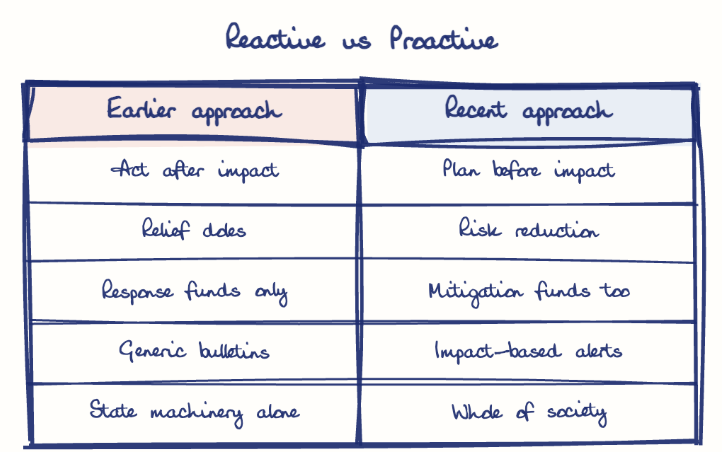
Discuss the recent measures initiated in disaster management by the Government of India departing from the earlier reactive approach.
In short
India has replaced relief-centred responses with prevention through Sendai-aligned plans, mitigation funds, a larger NDRF, early warning and community volunteers. Accurate forecasts let Odisha evacuate about 1.2 million people before Cyclone Fani in 2019.
Model answer
Ghissu Editorial · Verified 4 Oct 2026 · 307 words
Sendai-aligned planning
The National Disaster Management Plan (2016, revised 2019) fixes each ministry's prevention duties, and the DM (Amendment) Act, 2025 creates urban disaster authorities.
Money for mitigation
The Fifteenth Finance Commission created mitigation funds, reserving 20% of the state disaster pool for prevention.
Standing response force
The NDRF has grown from 8 battalions in 2006 to 16 (PIB, 2025), so teams are pre-positioned before landfall.
Hazard-specific plans
Heat action plans, first made in Ahmedabad (2013), and NDMA's glacial lake flood guidelines (2020) cover hazards once ignored.
Early warning
IMD forecasts let Odisha evacuate about 1.2 million people before Cyclone Fani (2019), and SACHET sends location-specific alerts to phones.
Community responders
Aapda Mitra trains local volunteers, and Exercise Suraksha Chakra (2025) drilled 55 Delhi-NCR sites for an earthquake.
Risk knowledge and global role
Seismic observatories rose from 80 in 2014 to 168 by 2025 (PIB), and India launched the Coalition for Disaster Resilient Infrastructure in 2019.
Use mitigation funds
Uptake of the new windows stayed below 20% (World Bank, 2025).
Empower DDMAs
Turn district relief cells into risk planners.
This model answer is indicative and the model can make mistakes; please verify key facts independently.
Practise this question
1Get the answer sheet
Sized for this question.
2Write your answer
Timed, by hand.
3Get it marked
Your score and what to fix.
This chapter in the exam
Disaster Risk Reduction & Mitigation6 questions
Asked in 6 of 14 sittings since 2013
- 2026Discuss how the contradiction between 'rapid infrastructure development' and 'disaster-risk reduction' in ecologically-sensitive areas of India can be managed, with suitable examples. (Answer in 150 words)
- 2024What is disaster resilience? How is it determined? Describe various elements of a resilience framework. Also mention the global targets of Sendai Framework for Disaster Risk Reduction (2015-2030).
All 6 questions, sorted by sub-topic, with model answers and practice.
Question from the official UPSC Civil Services (Main) Examination 2020 paper. Answer written by Ghissu's engine and checked against our editorial standards. Found an error? Tell us and we correct it within 48 hours.