2020 · GS Paper 3 · Q17 · 15 marks
What are the key features of the National Clean Air Programme (NCAP) initiated by the Government of India?
In short
The National Clean Air Programme, launched in January 2019, is a city-focused plan that sets a time-bound particulate reduction target, funds city action plans on performance, expands monitoring and builds tiered institutions. Its revised target seeks up to a 40 percent cut in PM10 by 2025-26 over 2017 levels.
Model answer
Ghissu Editorial · Verified 4 Oct 2026 · 275 words
Time-bound target
The original goal of a 20 to 30 percent cut in particulate concentrations by 2024 was revised in 2022 to up to 40 percent in PM10 by 2025-26, over 2017 levels.
City action plans
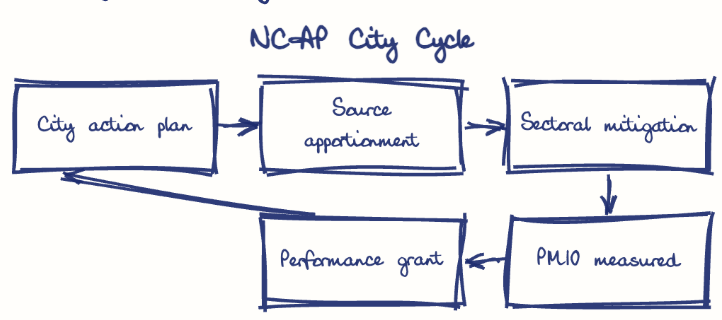
About 130 non-attainment and million-plus cities must implement plans against dust, vehicles, industry and burning, and had received ₹13,852.22 crore by 2025-26 (MoEFCC Annual Report), with grants linked to measured PM10 decline.
Data backbone
Wider monitoring networks, emission inventories, source apportionment studies and IIT-led knowledge partners guide each city to spend on its dominant sources.
Tiered governance
Apex, steering and monitoring committees at the Centre, state and city committees below, the PRANA portal and the Swachh Vayu Survekshan ranking, which Indore topped in 2023, enforce accountability.
Teeth and airsheds
Statutory backing and regional airshed plans, like the Commission for Air Quality Management in NCR, should replace city-only action.
Right priorities
Funds must shift from road dust to combustion sources, and the 2009 NAAQS, weaker than WHO guidelines, need revision.
This model answer is indicative and the model can make mistakes; please verify key facts independently.
Practise this question
1Get the answer sheet
Sized for this question.
2Write your answer
Timed, by hand.
3Get it marked
Your score and what to fix.
This chapter in the exam
Environmental Pollution and Degradation13 questions
Asked in 11 of 14 sittings since 2013
- 2026What are the challenges to solid waste management in India? Discuss the governmental policy framework on solid waste management. Discuss the success/failure cases of Delhi and Indore cities highlighting the salient feature of their solid waste management initiatives. (Answer in 250 words)
- 2025Examine the factors responsible for depleting groundwater in India. What are the steps taken by the government to mitigate such depletion of groundwater ?
All 13 questions, sorted by sub-topic, with model answers and practice.
Question from the official UPSC Civil Services (Main) Examination 2020 paper. Answer written by Ghissu's engine and checked against our editorial standards. Found an error? Tell us and we correct it within 48 hours.