2020 · GS Paper 3 · Q13 · 15 marks
What are the major factors responsible for making rice-wheat system a success? In spite of this success how has this system become bane in India?
In short
The rice-wheat system succeeded through HYV seeds, assured irrigation, MSP with open-ended procurement and cheap inputs, but the same incentives caused groundwater mining, stubble burning, soil imbalance and monoculture. Punjab draws over 150% of its annual groundwater recharge.
Model answer
Ghissu Editorial · Verified 4 Oct 2026 · 295 words
Seeds and water
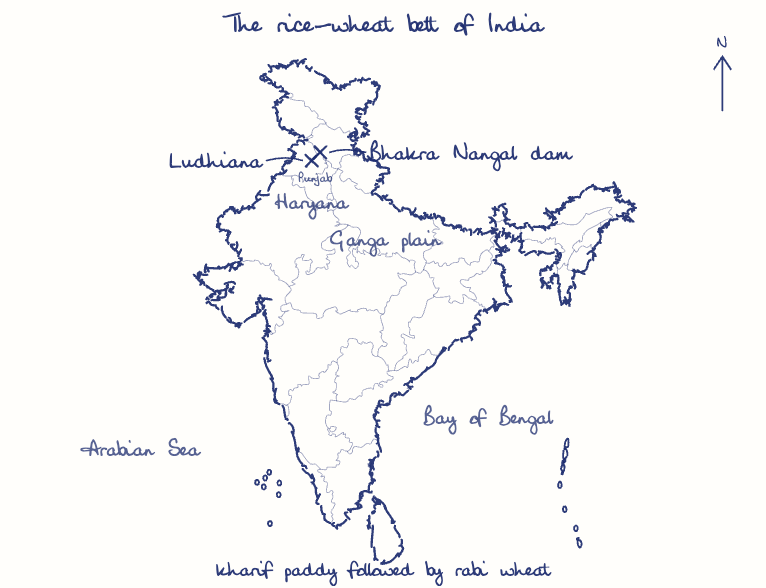
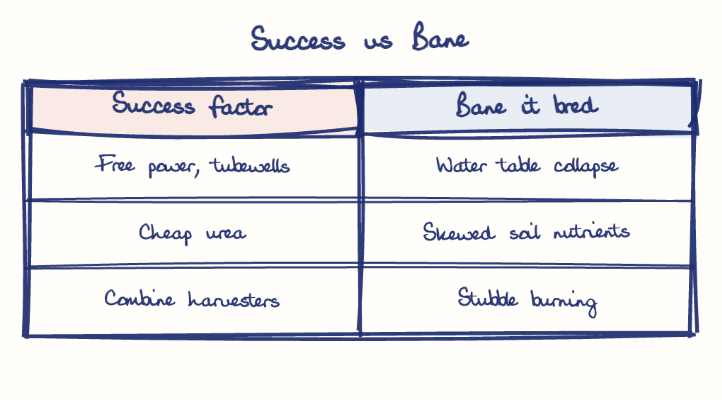
Borlaug's dwarf wheats, adapted under M.S. Swaminathan into Kalyan Sona and Sonalika, and IRRI's IR-8 rice met Bhakra canals and cheap-power tubewells in Punjab and Haryana.
Price guarantee and support
MSP from the Agricultural Prices Commission and open-ended FCI procurement, both dating from 1965, plus subsidised urea, credit and Punjab Agricultural University's extension, removed risk for these two crops alone.
Water and air
Punjab draws over 150% of its annual groundwater recharge (CGWB), and the 2009 subsoil water law's late transplanting squeezes the window before wheat, driving stubble burning.
Soil, diet and trade
Urea-heavy dosing depletes zinc and carbon, pulses and millets lose acreage, and rice support exceeded the WTO's 10% de minimis limit, peaking at 15.22% in 2021-22.
Diversify and save water
Haryana's Mera Pani Meri Virasat (₹7,000 an acre to leave paddy), direct seeded rice, Happy Seeder sowing and procurement of pulses under PM-AASHA and of millets for the PDS.
This model answer is indicative and the model can make mistakes; please verify key facts independently.
Practise this question
1Get the answer sheet
Sized for this question.
2Write your answer
Timed, by hand.
3Get it marked
Your score and what to fix.
This chapter in the exam
Major Crops and Cropping Patterns10 questions
Asked in 10 of 14 sittings since 2013
- 2026How Indian agriculture has been transformed from food scarcity to food surplus level? Explain the various government policies implemented for diversification of Indian agriculture. (Answer in 250 words)
- 2025Explain the factors influencing the decision of the farmers on the selection of high value crops in India.
All 10 questions, sorted by sub-topic, with model answers and practice.
Question from the official UPSC Civil Services (Main) Examination 2020 paper. Answer written by Ghissu's engine and checked against our editorial standards. Found an error? Tell us and we correct it within 48 hours.