2020 · GS Paper 3 · Q8 · 10 marks
What are the salient features of the Jal Shakti Abhiyan launched by the Government of India for water conservation and water security?
In short
The Jal Shakti Abhiyan, launched on 1 July 2019, was a time-bound people's campaign for water conservation that used officers, convergent funding and five core interventions. Its first phase covered 1,592 water-stressed blocks in 256 districts and later became JSA: Catch the Rain.
Model answer
Ghissu Editorial · Verified 4 Oct 2026 · 264 words
Targeted at water stress
Its first phase, from 1 July to 15 September 2019, covered 1,592 water-stressed blocks in 256 districts, with a second phase in October and November for states with a retreating monsoon.
Officers and convergence
Central officers worked with district teams, and works were funded by dovetailing MGNREGS, PMKSY, CAMPA and state schemes rather than a new fund.
A jan andolan
Gram sabhas, self-help groups, schools and Krishi Vigyan Kendra melas mobilised communities so that saving water became everyone's business.
Water from rainfall
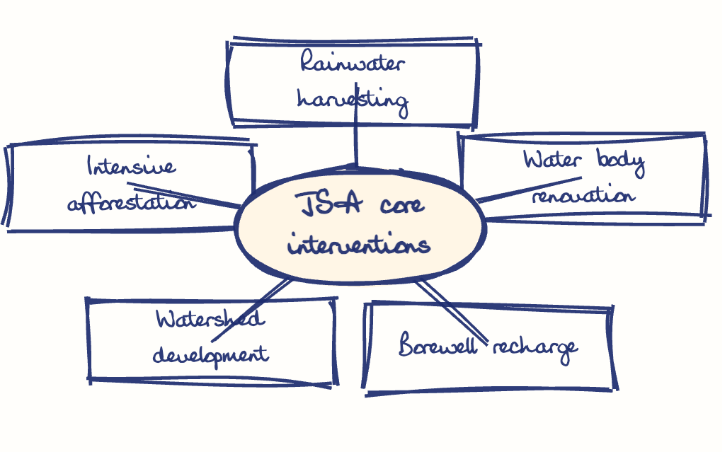
The five core interventions capture monsoon runoff where it falls and recharge aquifers instead of letting rain drain away.
Planning and tracking
Block and district water conservation plans, 3D contour mapping and geo-tagging made assets traceable.
Scaling up
JSA: Catch the Rain (2021) extended the campaign to every district with district Jal Shakti Kendras, and Mission Amrit Sarovar completed over 68,000 ponds by March 2025 (PIB).
This model answer is indicative and the model can make mistakes; please verify key facts independently.
Practise this question
1Get the answer sheet
Sized for this question.
2Write your answer
Timed, by hand.
3Get it marked
Your score and what to fix.
This chapter in the exam
Conservation19 questions
Asked in 11 of 14 sittings since 2013
- 2026Discuss the aim and goals of Kunming-Montreal global biodiversity framework. Mention India's commitments and initiatives to achieve the goals and targets of this framework giving suitable examples. (Answer in 150 words)
- 2025What is Carbon Capture, Utilization and Storage (CCUS) ? What is the potential role of CCUS in tackling climate change ?
All 19 questions, sorted by sub-topic, with model answers and practice.
Question from the official UPSC Civil Services (Main) Examination 2020 paper. Answer written by Ghissu's engine and checked against our editorial standards. Found an error? Tell us and we correct it within 48 hours.