2021 · GS Paper 1 · Q18 · 15 marks
Discuss the main objectives of Population Education and point out the measures to achieve them in India in detail.
In short
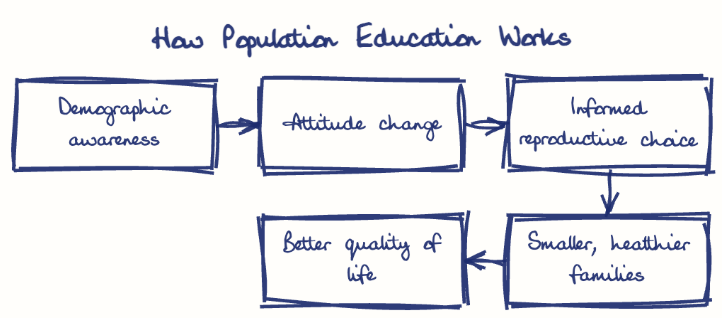
Population education aims at demographic literacy, responsible parenthood as free choice, adolescent reproductive health and gender equity, pursued through school curricula, adolescent health outreach and girls' schooling. NCERT's National Population Education Project (1980) and Mission Parivar Vikas (2016) in 146 high-fertility districts are the key measures.
Model answer
Ghissu Editorial · Verified 4 Oct 2026 · 279 words
Demographic literacy
Learners understand fertility, mortality, migration and age structure, and what the demographic dividend means for them.
Responsible parenthood
The small family is promoted as an informed choice, in line with the Cairo ICPD (1994) and India's target-free approach of 1996.
Health and gender equity
Adolescents learn about reproductive health and birth spacing, while son-preference and early marriage are challenged.
School curriculum
NCERT's National Population Education Project (1980) and the Adolescence Education Programme carry these themes into classrooms, backed by Health and Wellness Ambassadors under Ayushman Bharat (2020).
Health outreach
The Rashtriya Kishori Swasthya Karyakram (2014) uses peer educators, and Mission Parivar Vikas (2016) reached 146 high-fertility districts.
Girls' schooling
The RTE Act 2009 and the Prohibition of Child Marriage Act 2006 delay marriage, as Kerala's TFR of 1.8 with high female literacy shows.
Graded sexuality education
Make reproductive health a regular, assessed part of the school curriculum under NEP 2020.
Men and regions
Engage men, since female sterilisation covers 37.9% of married women (NFHS-5), and focus on high-fertility Bihar and Meghalaya.
This model answer is indicative and the model can make mistakes; please verify key facts independently.
Practise this question
1Get the answer sheet
Sized for this question.
2Write your answer
Timed, by hand.
3Get it marked
Your score and what to fix.
This chapter in the exam
Population and associated issues5 questions
Asked in 4 of 14 sittings since 2013
- 2026Critically examine the challenges of demographic transition in contemporary India.
- 2015Discuss the changes in the trends of labour migration within and outside India in the last four decades.
All 5 questions, sorted by sub-topic, with model answers and practice.
Question from the official UPSC Civil Services (Main) Examination 2021 paper. Answer written by Ghissu's engine and checked against our editorial standards. Found an error? Tell us and we correct it within 48 hours.