2026 · GS Paper 1 · Q19 · 15 marks
Critically examine the challenges of demographic transition in contemporary India.
In short
India's demographic transition is a success but brings challenges of jobs, women's low workforce participation, weak human capital, a north-south fertility gap and rapid ageing, which are manageable with planning. Youth made up about 83% of the unemployed in the India Employment Report 2024.
Model answer
Ghissu Editorial · Verified 4 Oct 2026 · 317 words
Jobs for the bulge
Youth made up about 83% of the unemployed (ILO-IHD India Employment Report 2024).
Missing women workers
Female labour force participation was only 41.7% in PLFS 2023-24, much of it unpaid family work.
Weak human capital
With 35.5% of under-five children stunted (NFHS-5), many youth enter work with low productivity.
North-south divide
Bihar's fertility near 3.0 against about 1.8 in Kerala (NFHS-5) means a bulge in the north while the south ages, fuelling delimitation and finance disputes after the 84th Amendment freeze.
Ageing before getting rich
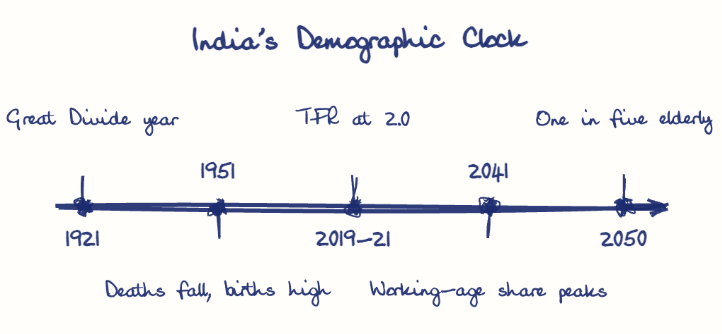
The India Ageing Report 2023 projects the elderly share rising from 10.5% in 2022 to 20.8% by 2050, mostly women, many widowed and without pensions.
Manageable, not alarming
Migration from younger northern states can fill southern labour gaps, making this a planning challenge rather than a crisis.
Jobs and care
Labour-intensive manufacturing, enforced creches and public elder care can absorb youth and women before the working-age share peaks around 2041.
Ageing and federal consensus
Add universal pensions to the 2024 PM-JAY health cover for those aged 70 and above, and settle delimitation through dialogue.
This model answer is indicative and the model can make mistakes; please verify key facts independently.
Practise this question
1Get the answer sheet
Sized for this question.
2Write your answer
Timed, by hand.
3Get it marked
Your score and what to fix.
This chapter in the exam
Population and associated issues5 questions
Asked in 4 of 14 sittings since 2013
- 2021Discuss the main objectives of Population Education and point out the measures to achieve them in India in detail.
- 2015Discuss the changes in the trends of labour migration within and outside India in the last four decades.
All 5 questions, sorted by sub-topic, with model answers and practice.
Question from the official UPSC Civil Services (Main) Examination 2026 paper. Answer written by Ghissu's engine and checked against our editorial standards. Found an error? Tell us and we correct it within 48 hours.