2021 · GS Paper 2 · Q16 · 15 marks
Has digital illiteracy, particularly in rural areas, coupled with lack of Information and Communication Technology (ICT) accessibility hindered socio-economic development? Examine with justification.
In short
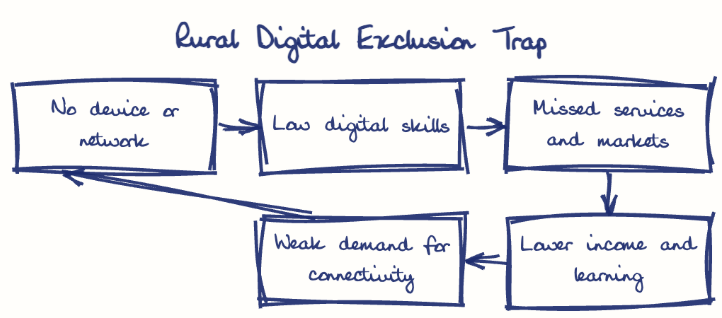
Digital illiteracy and poor ICT access have hindered rural socio-economic development by cutting villagers off from online education, welfare, markets and women's financial independence, though assisted access and UPI are narrowing the gap. The NSS 75th round found only 14.9% of rural households had internet access against 42% of urban households.
Model answer
Ghissu Editorial · Verified 4 Oct 2026 · 282 words
Education losses
In the 2020-21 school closures, children in homes without smartphones or data were cut off from online classes, widening learning gaps.
Welfare exclusion
The Supreme Court in 2021 questioned mandatory CoWIN registration because of the digital divide, and tribal Nandurbar (2026) still faces network-delayed welfare authentication.
Lost livelihoods
Farmers unable to use e-NAM or price apps sell through middlemen, and rural firms stay off GeM and ONDC.
Gendered divide
NFHS-5 found 33% of women had ever used the internet against 57% of men, which limits their access to digital credit and markets.
Assisted access
Common Service Centres and BC Sakhis let people without skills use e-services, and UPI has drawn rural vendors into digital payments.
Skilling and its limits
PMGDISHA (2017) targeted a digitally literate person in 6 crore rural households, but low literacy still exposes new users to cyber fraud and misinformation.
Connect, translate, train
Complete BharatNet's last mile, use Bhashini for vernacular services, and target women and safety literacy.
This model answer is indicative and the model can make mistakes; please verify key facts independently.
Practise this question
1Get the answer sheet
Sized for this question.
2Write your answer
Timed, by hand.
3Get it marked
Your score and what to fix.
This chapter in the exam
Education9 questions
Asked in 8 of 14 sittings since 2013
- 2026Should education be treated primarily as a welfare obligation of the state or as a strategic investment for building a globally competitive, knowledge-driven nation ? Critically evaluate.
- 2023Skill development programmes have succeeded in increasing human resources supply to various sectors. In the context of the statement analyse the linkages between education, skill and employment.
All 9 questions, sorted by sub-topic, with model answers and practice.
Question from the official UPSC Civil Services (Main) Examination 2021 paper. Answer written by Ghissu's engine and checked against our editorial standards. Found an error? Tell us and we correct it within 48 hours.