2021 · GS Paper 3 · Q7 · 10 marks
Describe the key points of the revised Global Air Quality Guidelines (AQGs) recently released by the World Health Organisation (WHO). How are these different from its last update in 2005 ? What changes in India's National Clean Air Programme are required to achieve these revised standards ?
In short
WHO's 2021 Air Quality Guidelines halve the annual PM2.5 value to 5 µg/m³, add new ozone, NO2 and CO metrics and four interim targets. India's NCAP must shift to PM2.5-based, airshed-wide and legally binding targets measured against a revision of India's 2009 NAAQS.
Model answer
Ghissu Editorial · Verified 4 Oct 2026 · 304 words
Six pollutants
Health-based levels are set for PM2.5, PM10, ozone, NO2, SO2 and CO from systematic reviews of health evidence.
Interim targets and good practice
Four particulate interim targets allow stepwise progress, and good practice statements cover black carbon, ultrafine particles and dust storms.
Halved benchmark
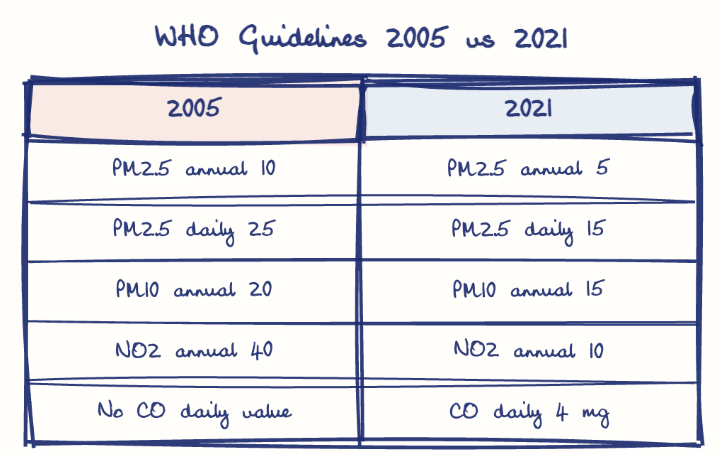
Annual PM2.5 fell from 10 to 5 µg/m³, so India's 40 µg/m³ standard is now eight times the guideline.
New metrics
Peak-season ozone, 24-hour NO2 and 24-hour CO values were added, while daily SO2 was relaxed from 20 to 40 µg/m³.
Health-based targets
NCAP should track PM2.5, not only a percentage cut in PM10 across 131 cities, against a revised NAAQS climbing the WHO interim targets, as the Parliamentary Standing Committee (2025) urged.
Airshed governance
Regional bodies modelled on the Commission for Air Quality Management (2021) should manage the Indo-Gangetic airshed.
Legal teeth and sources
Statutory backing, source apportionment and enforcement of the 2015 power-plant emission norms would tie funds to outcomes, with rural monitoring extended.
This model answer is indicative and the model can make mistakes; please verify key facts independently.
Practise this question
1Get the answer sheet
Sized for this question.
2Write your answer
Timed, by hand.
3Get it marked
Your score and what to fix.
This chapter in the exam
Environmental Pollution and Degradation13 questions
Asked in 11 of 14 sittings since 2013
- 2026What are the challenges to solid waste management in India? Discuss the governmental policy framework on solid waste management. Discuss the success/failure cases of Delhi and Indore cities highlighting the salient feature of their solid waste management initiatives. (Answer in 250 words)
- 2025Examine the factors responsible for depleting groundwater in India. What are the steps taken by the government to mitigate such depletion of groundwater ?
All 13 questions, sorted by sub-topic, with model answers and practice.
Question from the official UPSC Civil Services (Main) Examination 2021 paper. Answer written by Ghissu's engine and checked against our editorial standards. Found an error? Tell us and we correct it within 48 hours.