2022 · GS Paper 1 · Q12 · 15 marks
Discuss the main contributions of Gupta period and Chola period to Indian heritage and culture.
In short
The Guptas set India's classical canon in the structural temple, serene sculpture, Sanskrit literature and mathematics, while the Cholas took Dravidian temple building, bronze casting and Tamil devotional literature to their peak. Thanjavur's Brihadisvara, the Deogarh Dashavatara temple and Aryabhata's Aryabhatiya stand out.
Model answer
Ghissu Editorial · Verified 4 Oct 2026 · 281 words
Structural temple
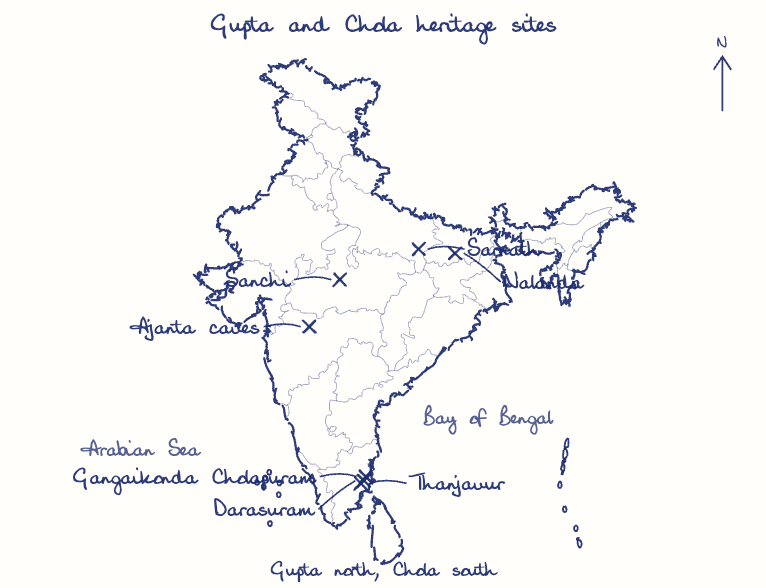
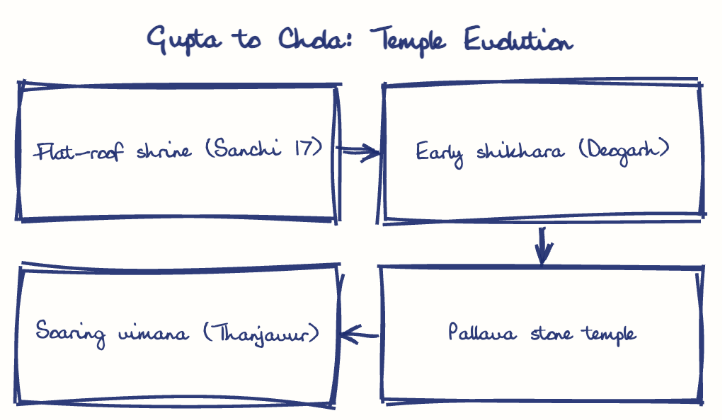
Shrines moved from caves to free-standing form, from the flat-roofed Sanchi Temple 17 to the Dashavatara temple at Deogarh, among the earliest with a shikhara.
Sculpture and letters
The Sarnath Buddha and Udayagiri Varaha fixed the ideal of serene form, and Kalidasa's Abhijnanashakuntalam raised Sanskrit to its classical height.
Science
Aryabhata's Aryabhatiya (499 CE) explained the earth's rotation, and the Mehrauli iron pillar still resists rust.
Monumental temples
Thanjavur's Brihadisvara (1010 CE), Gangaikondacholapuram and Darasuram, the UNESCO-listed Great Living Chola Temples, made the temple a hub of worship and economy.
Bronze casting
Lost-wax bronzes such as the Nataraja remain a world benchmark, a craft alive in Swamimalai's GI-tagged icons.
Literature and polity
Sekkizhar's Periya Puranam and Kamban's Ramavataram gave Bhakti a Tamil voice, and the Uttaramerur inscriptions record village assemblies chosen by lot.
Protect and teach
Repatriate stolen bronzes, as with the Sripuranthan Nataraja returned in 2014, and teach this heritage through Indian Knowledge Systems courses.
This model answer is indicative and the model can make mistakes; please verify key facts independently.
Practise this question
1Get the answer sheet
Sized for this question.
2Write your answer
Timed, by hand.
3Get it marked
Your score and what to fix.
This chapter in the exam
Architecture8 questions
Asked in 8 of 14 sittings since 2013
- 2026Vijayanagara architecture exemplifies the amalgamation of past traditions with contemporary practices. Elucidate with examples.
- 2025Discuss the salient features of the Harappan architecture.
All 8 questions, sorted by sub-topic, with model answers and practice.
Question from the official UPSC Civil Services (Main) Examination 2022 paper. Answer written by Ghissu's engine and checked against our editorial standards. Found an error? Tell us and we correct it within 48 hours.