2022 · GS Paper 1 · Q1 · 10 marks
How will you explain that medieval Indian temple sculptures represent the social life of those days?
In short
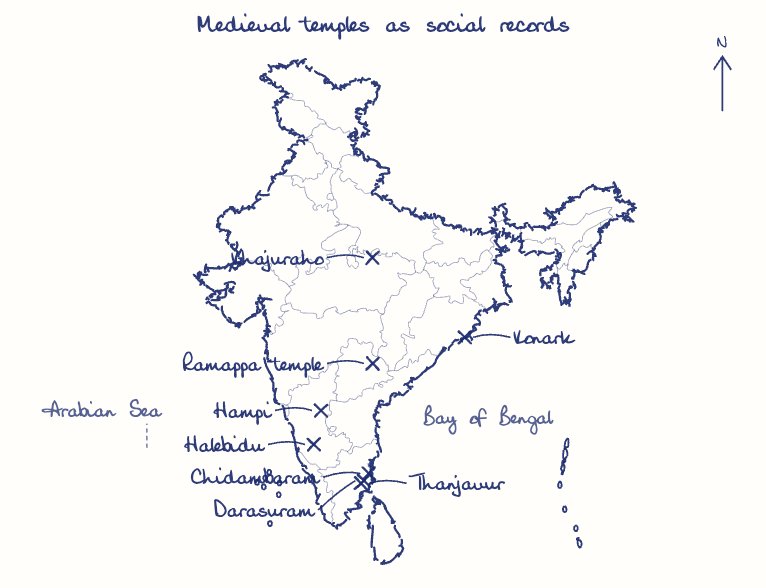
Medieval temple sculptures record the social life of their age: court and warfare at Khajuraho and Halebidu, the horse trade at Hampi, dance at Chidambaram and Ramappa, and women's daily routine. Rajaraja I's Thanjavur inscriptions, listing about 400 temple dancers, confirm that the carvings reflect real institutions.
Model answer
Ghissu Editorial · Verified 4 Oct 2026 · 270 words
Court and warfare
The Lakshmana temple frieze at Khajuraho (954 CE) and the plinth of the Hoysaleswara temple at Halebidu show soldiers, war elephants, horsemen and processions.
Trade and economy
Hampi's Mahanavami Dibba carves horses led by foreign traders, echoing Vijayanagara's import of war horses from Arabia and Persia.
Dance and music
Chidambaram's gopurams carve the 108 karanas of the Natya Shastra, and Ramappa's dancing figures match Jayapa Senani's Nritta Ratnavali.
Women and daily life
Khajuraho's surasundaris apply kohl, write letters and play with children, recording dress and domestic routine.
Devotion
Darasuram's Airavatesvara temple narrates the lives of the 63 Nayanars, showing a Bhakti that reached hunters, potters and women saints.
Confirmed by inscriptions
Rajaraja I's Thanjavur inscriptions list about 400 temple dancers, matching the dancers on its walls.
Idealised and elite
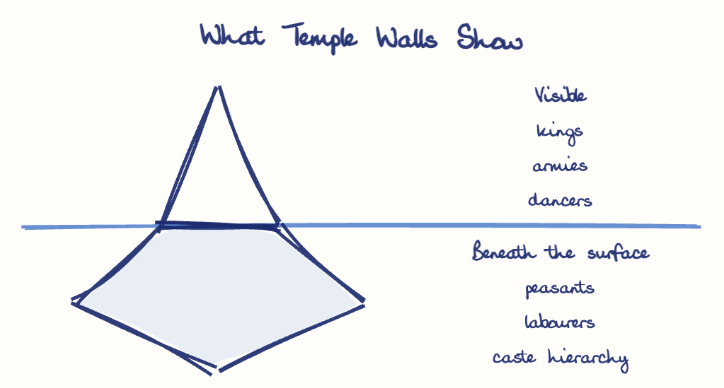
Shilpa shastra canons and royal taste meant the court appears far more often than the peasant or the labouring castes.
This model answer is indicative and the model can make mistakes; please verify key facts independently.
Practise this question
1Get the answer sheet
Sized for this question.
2Write your answer
Timed, by hand.
3Get it marked
Your score and what to fix.
This chapter in the exam
Art Forms10 questions
Asked in 8 of 14 sittings since 2013
- 2025The sculptors filled the Chandella artform with resilient vigor and breadth of life.' Elucidate.
- 2022Discuss the significance of the lion and bull figures in Indian mythology, art and architecture.
All 10 questions, sorted by sub-topic, with model answers and practice.
Question from the official UPSC Civil Services (Main) Examination 2022 paper. Answer written by Ghissu's engine and checked against our editorial standards. Found an error? Tell us and we correct it within 48 hours.