2022 · GS Paper 1 · Q14 · 15 marks
What are the forces that influence ocean currents? Describe their role in fishing Industry of the world.
In short
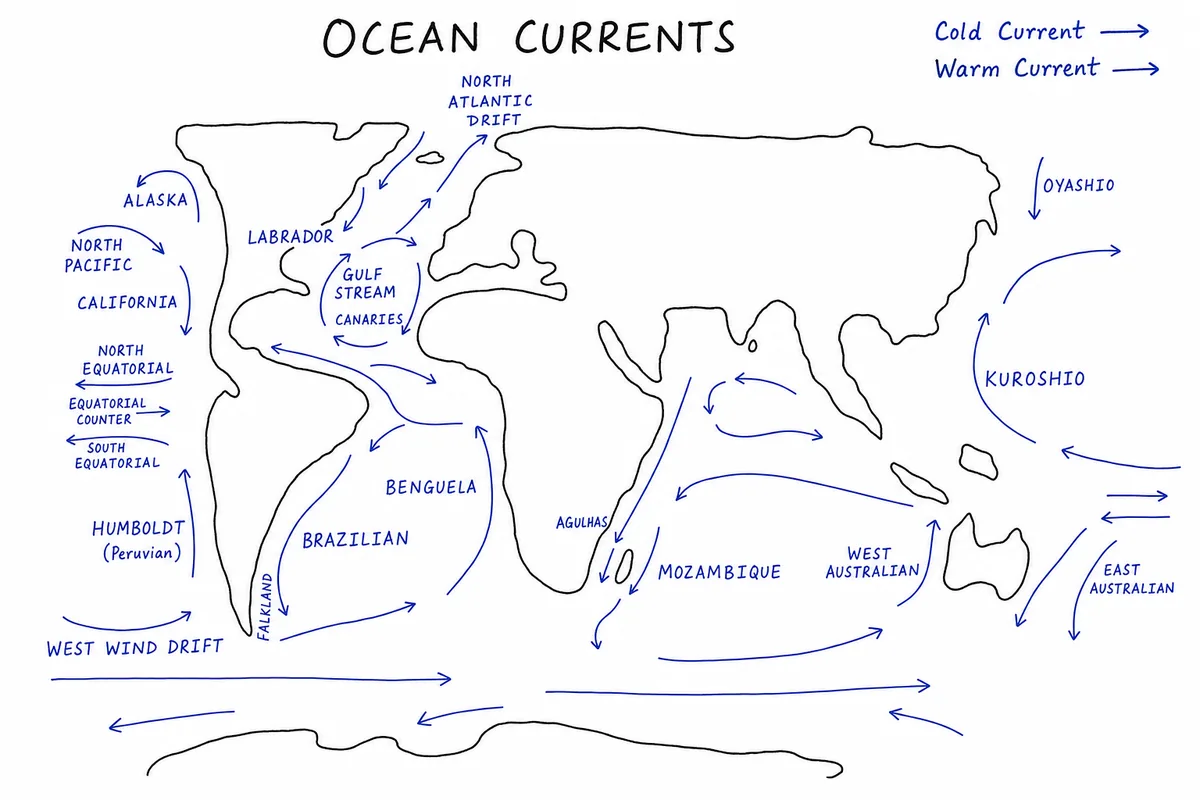
Ocean currents are driven by planetary winds, the Coriolis force, density differences from temperature and salinity, and gravity and coastline shape, and they create rich fisheries where warm and cold waters meet or cold water upwells. The Gulf Stream and Labrador current together make the Grand Banks fishing ground.
Model answer
Ghissu Editorial · Verified 4 Oct 2026 · 278 words
Planetary winds
Trade winds and westerlies drag surface water, and the monsoon reverses north Indian Ocean currents twice a year.
Coriolis force
Rotation deflects currents right in the Northern Hemisphere and left in the Southern, forming gyres.
Density differences
Temperature and salinity drive the thermohaline circulation, such as the saline Mediterranean outflow at Gibraltar.
Gravity and coastlines
Landmasses steer flows, as Cape Sao Roque splits the South Equatorial Current.
Warm and cold convergence
The Gulf Stream and Labrador current create the Grand Banks, and the Kuroshio and Oyashio enrich the grounds off Japan.
Upwelling zones
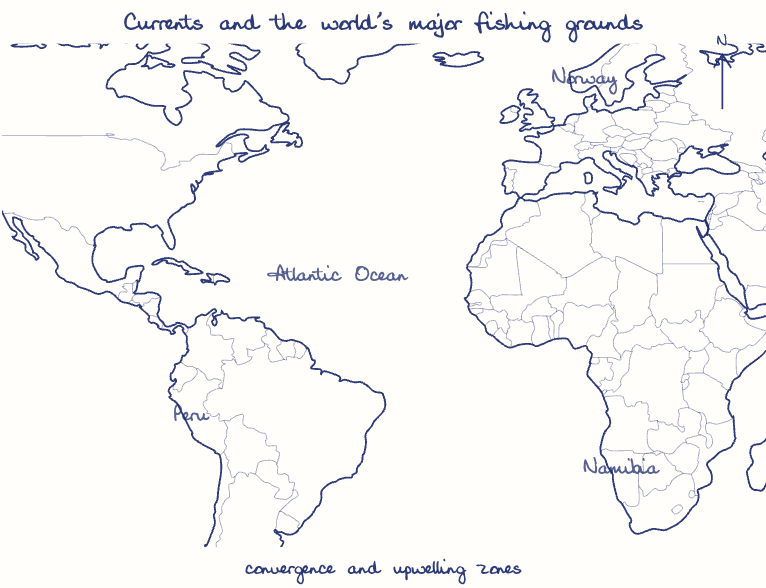
Cold currents on western margins lift nutrients, sustaining Peru's anchoveta fishery of the Humboldt current and the Benguela fishery off Namibia.
Ice-free coasts
The North Atlantic Drift keeps Norway's coast open for year-round fishing.
Weak tropical fisheries
Warm tropical waters yield less, though monsoon upwelling off Kerala supports the oil sardine, and El Nino collapsed Peru's anchoveta catch in 1972-73.
Advisories and quotas
INCOIS Potential Fishing Zone advisories and science-based catch limits, the lesson of Canada's 1992 cod moratorium, should go together.
This model answer is indicative and the model can make mistakes; please verify key facts independently.
Practise this question
1Get the answer sheet
Sized for this question.
2Write your answer
Timed, by hand.
3Get it marked
Your score and what to fix.
This chapter in the exam
Water (Oceans)4 questions
Asked in 4 of 14 sittings since 2013
- 2019How do ocean currents and water masses differ in their impacts on marine life and coastal environment? Give suitable examples.
- 2017Account for variations in oceanic salinity and discuss its multi-dimensional effects.
All 4 questions, sorted by sub-topic, with model answers and practice.
Question from the official UPSC Civil Services (Main) Examination 2022 paper. Answer written by Ghissu's engine and checked against our editorial standards. Found an error? Tell us and we correct it within 48 hours.