2022 · GS Paper 2 · Q11 · 15 marks
Discuss the procedures to decide the disputes arising out of the election of a Member of the Parliament or State Legislature under The Representation of the People Act, 1951. What are the grounds on which the election of any returned candidate may be declared void? What remedy is available to the aggrieved party against the decision? Refer to the case laws.
In short
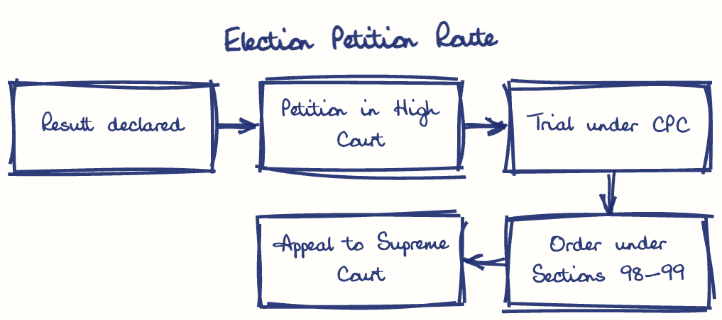
Election disputes under the Representation of the People Act, 1951 are settled only by a petition in the High Court within 45 days, which may void an election under Section 100 for disqualification, corrupt practice or material irregularity. The aggrieved party can appeal to the Supreme Court within 30 days under Section 116A.
Model answer
Ghissu Editorial · Verified 4 Oct 2026 · 309 words
High Court forum
Under Sections 80A and 81, any candidate or elector files in the High Court within 45 days, with an affidavit supporting any corrupt-practice charge (Section 83).
Trial and order
Defective petitions are dismissed under Section 86 (Azhar Hussain, 1986); trial follows the CPC, should end in six months, and closes with dismissal, a void election or another candidate declared elected.
Disqualification and corrupt practice
Section 100(1)(a)-(b) voids an election if the winner was not qualified or committed a Section 123 corrupt practice, as in Indira Gandhi v Raj Narain (1975).
Nomination and counting errors
Improper rejection of a nomination voids the election outright; improper acceptance, wrongly counted votes or breach of the rules do so if the result was materially affected, and Krishnamoorthy (2015) treated hidden criminal antecedents as undue influence.
Appeal and stay
Section 116A allows an appeal to the Supreme Court within 30 days, and Section 116B a stay of the order.
Corrupt-practice referral
Under Section 8A the President decides disqualification of up to six years on the Election Commission's opinion.
Faster disposal
Dedicated election benches would make the six-month rule, and so the remedy, real.
This model answer is indicative and the model can make mistakes; please verify key facts independently.
Practise this question
1Get the answer sheet
Sized for this question.
2Write your answer
Timed, by hand.
3Get it marked
Your score and what to fix.
This chapter in the exam
Salient features of the Representation of People’s Act6 questions
Asked in 6 of 14 sittings since 2013
- 2025Discuss the corrupt practices for the purpose of the Representation of the People Act, 1951. Analyze whether the increase in the assets of the legislators and/or their associates, disproportionate to their known sources of income, would constitute undue influence and consequently a corrupt practice.
- 2024Examine the need for electoral reforms as suggested by various Committees with particular reference to one nation-one election principle.
All 6 questions, sorted by sub-topic, with model answers and practice.
Question from the official UPSC Civil Services (Main) Examination 2022 paper. Answer written by Ghissu's engine and checked against our editorial standards. Found an error? Tell us and we correct it within 48 hours.