2024 · GS Paper 2 · Q1 · 10 marks
Examine the need for electoral reforms as suggested by various Committees with particular reference to one nation-one election principle.
In short
Committees from Tarkunde to Kovind sought electoral reform to curb money power, criminalisation and costly continuous campaigning, and one nation one election addresses the last while raising federal and accountability concerns. The Kovind Committee (2024) recommended synchronised Lok Sabha and Assembly polls, with local bodies within 100 days.
Model answer
Ghissu Editorial · Verified 4 Oct 2026 · 294 words
India voted simultaneously from 1951-52 to 1967, until early dissolutions broke the cycle. The Kovind Committee (2024) revived that model, continuing a long line of committees seeking electoral reform under Articles 324 to 329.
Why Committees Have Sought Electoral Reform
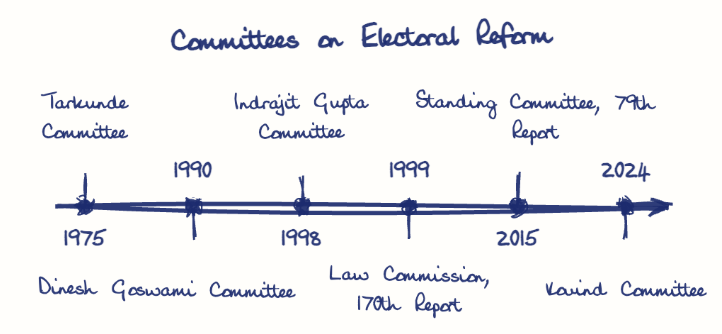
Committees on Electoral Reform → 1975 :: Tarkunde Committee → 1990 :: Dinesh Goswami Committee → 1998 :: Indrajit Gupta Committee → 1999 :: Law Commission, 170th Report → 2015 :: Standing Committee, 79th Report → 2024 :: Kovind Committee
1. Money power: The Indrajit Gupta Committee backed state funding in kind, a need sharpened after electoral bonds were struck down in 2024. 2. Criminalisation: The Vohra Committee (1993) exposed the criminal-politician nexus, and the Law Commission's 244th Report (2014) proposed disqualification on framing of serious charges. 3. Independent referee: The Goswami Committee sought a neutral process to appoint the Election Commission, a demand echoed in Anoop Baranwal (2023). 4. Continuous campaigning: The Law Commission's 170th Report and the Standing Committee's 79th Report found near-constant elections costly for money and governance.
Policy continuity
Fewer Model Code periods would end repeated freezes on projects, as the Kovind Committee argued for synchronised Lok Sabha and Assembly polls.
Cost and manpower
One cycle avoids repeated deployment of forces and officials.
Federal concerns
Curtailing Assembly terms may weaken state autonomy, part of the basic structure since S.R. Bommai (1994).
Accountability
Fewer polls mean fewer checks, so the 129th Amendment Bill, 2024 went to a Joint Parliamentary Committee.
This model answer is indicative and the model can make mistakes; please verify key facts independently.
Practise this question
1Get the answer sheet
Sized for this question.
2Write your answer
Timed, by hand.
3Get it marked
Your score and what to fix.
This chapter in the exam
Salient features of the Representation of People’s Act6 questions
Asked in 6 of 14 sittings since 2013
- 2025Discuss the corrupt practices for the purpose of the Representation of the People Act, 1951. Analyze whether the increase in the assets of the legislators and/or their associates, disproportionate to their known sources of income, would constitute undue influence and consequently a corrupt practice.
- 2022Discuss the procedures to decide the disputes arising out of the election of a Member of the Parliament or State Legislature under The Representation of the People Act, 1951. What are the grounds on which the election of any returned candidate may be declared void? What remedy is available to the aggrieved party against the decision? Refer to the case laws.
All 6 questions, sorted by sub-topic, with model answers and practice.
Question from the official UPSC Civil Services (Main) Examination 2024 paper. Answer written by Ghissu's engine and checked against our editorial standards. Found an error? Tell us and we correct it within 48 hours.