2025 · GS Paper 2 · Q1 · 10 marks
Discuss the corrupt practices for the purpose of the Representation of the People Act, 1951. Analyze whether the increase in the assets of the legislators and/or their associates, disproportionate to their known sources of income, would constitute undue influence and consequently a corrupt practice.
In short
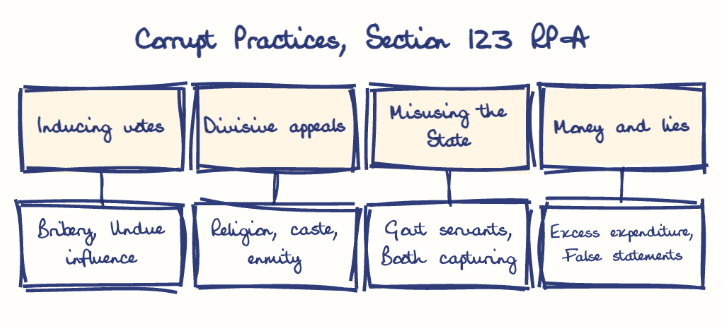
Section 123 of the RPA, 1951 lists corrupt practices such as bribery, undue influence, divisive appeals and booth capturing, and disproportionate assets amount to undue influence only when concealed or used to sway voters. Lok Prahari (2018) held that non-disclosure of assets and their sources is undue influence.
Model answer
Ghissu Editorial · Verified 4 Oct 2026 · 294 words
Bribery and undue influence
Section 123(1) bars gratification for votes, and 123(2) bars any interference with the free exercise of an electoral right.
Divisive appeals
Appeals on religion, caste or language are barred, and Abhiram Singh (2017) extended this to the religion of voters as well as candidates.
Consequences
A High Court finding voids the election under Section 100, with disqualification of up to six years under Section 8A.
Case for inclusion
Lok Prahari (2018) reasoned that unexplained growth in legislators' assets suggests abuse of office and held that non-disclosure of assets and sources amounts to undue influence.
Voter's right to know
ADR (2002) and PUCL (2003) tied asset disclosure to free choice under Article 19(1)(a).
Case against
Section 123(2) needs interference with the vote itself, and lawful wealth cannot be presumed coercive.
Better remedy
Illicit enrichment is punishable under Section 13(1)(b) of the Prevention of Corruption Act, 1988, before a criminal court with proper evidence.
This model answer is indicative and the model can make mistakes; please verify key facts independently.
Practise this question
1Get the answer sheet
Sized for this question.
2Write your answer
Timed, by hand.
3Get it marked
Your score and what to fix.
This chapter in the exam
Salient features of the Representation of People’s Act6 questions
Asked in 6 of 14 sittings since 2013
- 2024Examine the need for electoral reforms as suggested by various Committees with particular reference to one nation-one election principle.
- 2022Discuss the procedures to decide the disputes arising out of the election of a Member of the Parliament or State Legislature under The Representation of the People Act, 1951. What are the grounds on which the election of any returned candidate may be declared void? What remedy is available to the aggrieved party against the decision? Refer to the case laws.
All 6 questions, sorted by sub-topic, with model answers and practice.
Question from the official UPSC Civil Services (Main) Examination 2025 paper. Answer written by Ghissu's engine and checked against our editorial standards. Found an error? Tell us and we correct it within 48 hours.