2022 · GS Paper 2 · Q2 · 10 marks
Right of movement and residence throughout the territory of India are freely available to the Indian citizens, but these rights are not absolute. Comment.
In short
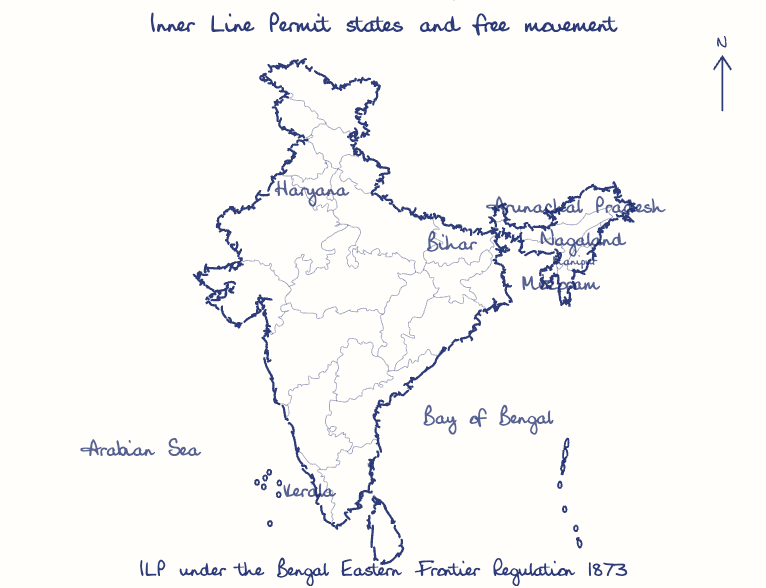
The rights of movement and residence under Articles 19(1)(d) and (e) are broad but subject to reasonable restrictions under Article 19(5) for public interest and Scheduled Tribes. The Inner Line Permit in four north-eastern States shows how tribal protection limits outsiders' entry.
Model answer
Ghissu Editorial · Verified 4 Oct 2026 · 269 words
One citizenship
With no State citizenship, a worker from Bihar can settle in Kerala on equal terms, which aids national integration.
Against nativism
Article 16(3) reserves residence conditions for public jobs to Parliament, and in 2023 the Punjab and Haryana High Court struck down Haryana's 75% local quota in private jobs.
Portable welfare
One Nation One Ration Card makes the right real for internal migrants.
Public order
Gurbachan Singh (1952) upheld externment of dangerous persons, and Section 163 BNSS orders curb movement during unrest.
Scheduled Tribes
The Inner Line Permit under the 1873 Regulation guards Arunachal Pradesh, Nagaland, Mizoram and Manipur, and Fifth and Sixth Schedule areas limit outsiders' settlement.
Health and morality
Pandemic quarantine rules, and State of U.P. v. Kaushalya (1964) upholding restraints on sex workers' residence, rest on these grounds.
Judicial limits
Kharak Singh (1962) struck down night domiciliary visits, and Anuradha Bhasin (2020) demanded proportionate prohibitory orders.
This model answer is indicative and the model can make mistakes; please verify key facts independently.
Practise this question
1Get the answer sheet
Sized for this question.
2Write your answer
Timed, by hand.
3Get it marked
Your score and what to fix.
This chapter in the exam
Significant Provisions — Fundamental Rights9 questions
Asked in 8 of 14 sittings since 2013
- 2026Right to privacy relating to self-identity is very dear to every human being and well protected under Article 21 of the Constitution. In this context, examine the effect of the amendment in 2026, to the Transgender Persons (Protection of Rights) Act, 2019.
- 2024Right to privacy is intrinsic to life and personal liberty and is inherently protected under Article 21 of the constitution. Explain. In this reference discuss the law relating to D.N.A. testing of child in the womb to establish paternity.
All 9 questions, sorted by sub-topic, with model answers and practice.
Question from the official UPSC Civil Services (Main) Examination 2022 paper. Answer written by Ghissu's engine and checked against our editorial standards. Found an error? Tell us and we correct it within 48 hours.