2022 · GS Paper 2 · Q1 · 10 marks
The most significant achievement of modern law in India is the constitutionalization of environmental problems by the Supreme Court. Discuss this statement with the help of relevant case laws.
In short
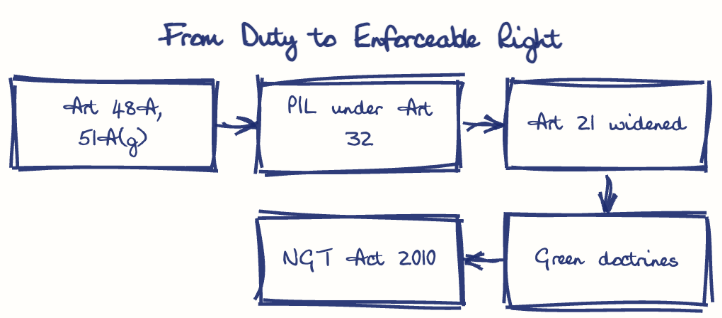
The Supreme Court constitutionalised environmental problems by reading a healthy environment into Article 21 and making doctrines such as absolute liability, polluter pays and public trust part of Indian law. Subhash Kumar (1991) recognised pollution-free water and air as part of the right to life.
Model answer
Ghissu Editorial · Verified 4 Oct 2026 · 274 words
Environment as life
The Dehradun quarrying case (1985) closed limestone quarries, and Subhash Kumar (1991) held that the right to life includes pollution-free water and air.
Absolute liability
M.C. Mehta (Oleum gas leak, 1987) made hazardous industries absolutely liable, without the Rylands v Fletcher exceptions.
Doctrines made law
Vellore Citizens Welfare Forum (1996) adopted the precautionary and polluter pays principles, and M.C. Mehta v Kamal Nath (1997) applied the public trust doctrine to the Beas riverbed.
Judicial overreach
The CNG order for Delhi's buses (1998) and fixed cracker hours show courts framing executive policy.
Implementation gap
Decades of orders on the Ganga and Delhi's air have not delivered clean water or air, because pollution control boards stay weak.
Inconsistency
In 2025 the Court struck down ex post facto clearances in Vanashakti, then recalled that ruling within months.
This model answer is indicative and the model can make mistakes; please verify key facts independently.
Practise this question
1Get the answer sheet
Sized for this question.
2Write your answer
Timed, by hand.
3Get it marked
Your score and what to fix.
This chapter in the exam
Significant Provisions — Fundamental Rights9 questions
Asked in 8 of 14 sittings since 2013
- 2026Right to privacy relating to self-identity is very dear to every human being and well protected under Article 21 of the Constitution. In this context, examine the effect of the amendment in 2026, to the Transgender Persons (Protection of Rights) Act, 2019.
- 2024Right to privacy is intrinsic to life and personal liberty and is inherently protected under Article 21 of the constitution. Explain. In this reference discuss the law relating to D.N.A. testing of child in the womb to establish paternity.
All 9 questions, sorted by sub-topic, with model answers and practice.
Question from the official UPSC Civil Services (Main) Examination 2022 paper. Answer written by Ghissu's engine and checked against our editorial standards. Found an error? Tell us and we correct it within 48 hours.