2022 · GS Paper 2 · Q18 · 15 marks
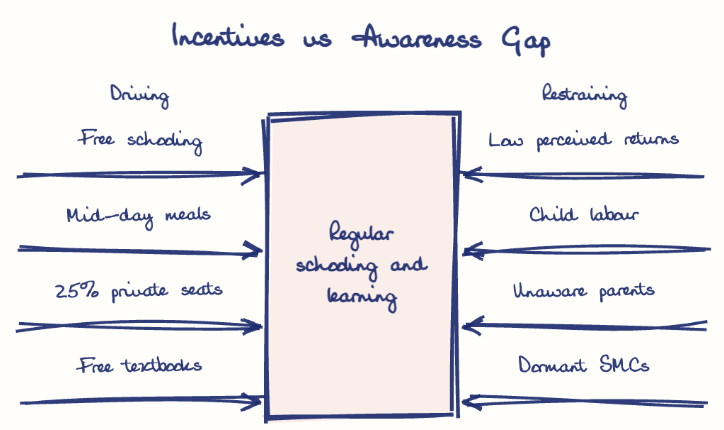
The Right of Children to Free and Compulsory Education Act, 2009 remains inadequate in promoting incentive-based system for children's education without generating awareness about the importance of schooling. Analyse.
In short
The RTE Act, 2009 removed cost barriers through free schooling, material incentives and a 25% private-school quota, but without parental awareness these produced enrolment rather than attendance and learning. ASER 2024 found only 23.4% of Class 3 government-school children could read a Class 2 text.
Model answer
Ghissu Editorial · Verified 4 Oct 2026 · 289 words
Free schooling
Sections 3 and 13 remove fees, capitation and screening, and state rules add free textbooks and uniforms alongside the mid-day meal.
Section 12(1)(c) quota
Private schools reserve 25% of entry seats for disadvantaged children at state cost, and the no-detention clause aimed to keep them in school.
Unclaimed entitlements
IIM Ahmedabad's studies found many quota seats unfilled because parents did not know the right or the process.
Enrolment without attendance
Where schooling seems to offer little return, child labour and early marriage win; Census 2011 counted about 1 crore working children aged 5-14.
Dormant SMCs
Parents hold three-fourths of SMC seats under Section 21, but rarely use them.
Passive promotion
Without parental demand for learning, no-detention became automatic promotion, diluted by the 2019 amendment. Teacher vacancies, as PROBE (1999) showed, add a supply gap.
Awareness plus learning
Scale Gujarat's Shala Praveshotsav drives, train SMCs, and track learning through NIPUN Bharat and PARAKH so parents see results.
This model answer is indicative and the model can make mistakes; please verify key facts independently.
Practise this question
1Get the answer sheet
Sized for this question.
2Write your answer
Timed, by hand.
3Get it marked
Your score and what to fix.
This chapter in the exam
Education9 questions
Asked in 8 of 14 sittings since 2013
- 2026Should education be treated primarily as a welfare obligation of the state or as a strategic investment for building a globally competitive, knowledge-driven nation ? Critically evaluate.
- 2023Skill development programmes have succeeded in increasing human resources supply to various sectors. In the context of the statement analyse the linkages between education, skill and employment.
All 9 questions, sorted by sub-topic, with model answers and practice.
Question from the official UPSC Civil Services (Main) Examination 2022 paper. Answer written by Ghissu's engine and checked against our editorial standards. Found an error? Tell us and we correct it within 48 hours.