2022 · GS Paper 3 · Q7 · 10 marks
Discuss in detail the photochemical smog emphasizing its formation, effects and mitigation. Explain the 1999 Gothenburg Protocol.
In short
Photochemical smog forms when sunlight drives reactions between nitrogen oxides and VOCs, producing ozone and PAN that harm lungs, crops and materials, and is cut by controlling these precursors. The 1999 Gothenburg Protocol set binding national ceilings for SO2, NOx, VOCs and ammonia, adding PM2.5 in 2012.
Model answer
Ghissu Editorial · Verified 4 Oct 2026 · 281 words
Secondary pollutant
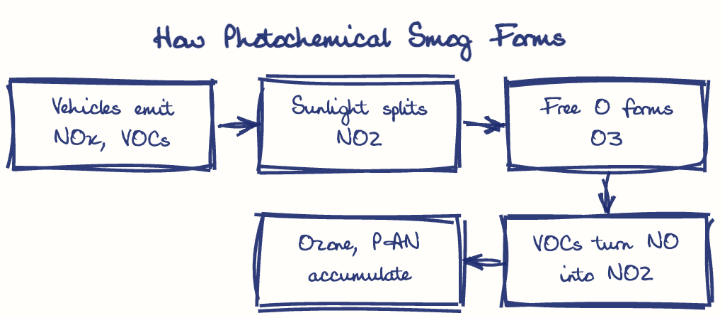
NO2 splits in sunlight, the freed oxygen atom forms ozone, and VOC radicals keep regenerating NO2 from NO, so ozone, PAN and aldehydes accumulate instead of being consumed.
Conditions
Strong sunshine, heat, calm air and temperature inversion make ozone peak on summer afternoons.
Health and crops
Ozone and PAN irritate eyes and airways and worsen asthma, and ozone entering leaf stomata cuts wheat and rice yields.
Materials and climate
It cracks rubber, causes haze and acts as a short-lived climate pollutant.
Cutting precursors
Bharat Stage VI norms (2020), vapour recovery at petrol pumps, FAME electric mobility and public transport reduce NOx and VOCs, while GRAP curbs emissions on bad days.
Framework
Under the UNECE Convention on Long-range Transboundary Air Pollution, it targets acidification, eutrophication and ground-level ozone, in force since 2005.
Ceilings
It fixed binding national emission ceilings for SO2, NOx, VOCs and ammonia for 2010, treating shared precursors together; the 2012 amendment added PM2.5 for 2020, the first binding particulate limits. India is not a party, but the model suits its airsheds.
This model answer is indicative and the model can make mistakes; please verify key facts independently.
Practise this question
1Get the answer sheet
Sized for this question.
2Write your answer
Timed, by hand.
3Get it marked
Your score and what to fix.
This chapter in the exam
Environmental Pollution and Degradation13 questions
Asked in 11 of 14 sittings since 2013
- 2026What are the challenges to solid waste management in India? Discuss the governmental policy framework on solid waste management. Discuss the success/failure cases of Delhi and Indore cities highlighting the salient feature of their solid waste management initiatives. (Answer in 250 words)
- 2025Examine the factors responsible for depleting groundwater in India. What are the steps taken by the government to mitigate such depletion of groundwater ?
All 13 questions, sorted by sub-topic, with model answers and practice.
Question from the official UPSC Civil Services (Main) Examination 2022 paper. Answer written by Ghissu's engine and checked against our editorial standards. Found an error? Tell us and we correct it within 48 hours.