2022 · GS Paper 3 · Q11 · 15 marks
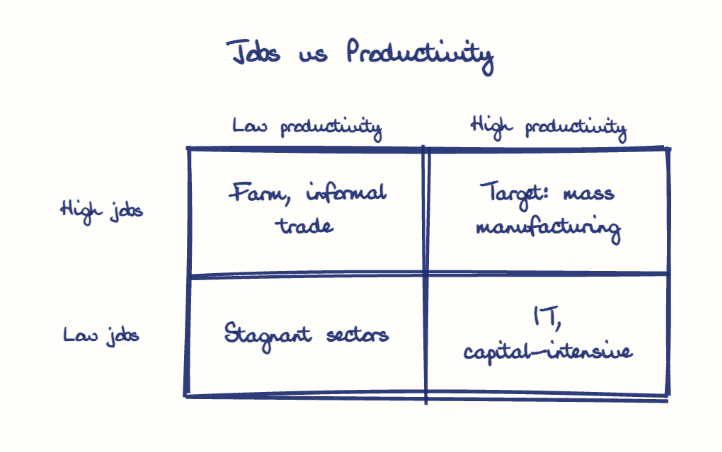
"Economic growth in the recent past has been led by increase in labour productivity." Explain this statement. Suggest the growth pattern that will lead to creation of more jobs without compromising labour productivity.
In short
India's recent growth came mainly from rising output per worker through capital deepening and capital-intensive sectors, not from more employment, so job creation lagged. A pattern led by labour-intensive manufacturing, scaled-up MSMEs and job-rich services can raise both jobs and productivity, as labour productivity grew 6.2% a year in 2003-17.
Model answer
Ghissu Editorial · Verified 4 Oct 2026 · 284 words
Within-sector Gains
About 75% of productivity growth in 2011-17 came from technology and capital deepening inside sectors.
Capital-intensive Leaders
IT, telecom, automobiles and finance use skilled labour and machines, so they expanded output far faster than headcount.
Jobless Growth
Employment grew under 1% a year in 2004-12 while GDP grew near 8%, even as agriculture's workforce share fell from 58% to 49%.
Labour-intensive Manufacturing
Apparel, footwear, toys and electronics assembly, backed by PM MITRA parks and PLI, can employ millions, as they did in Bangladesh and Vietnam.
Scaling MSMEs
The "dwarf" firms flagged by the Economic Survey 2018-19 must be helped to grow, since larger firms are more productive and hire more.
Services and Agri Value Chains
Tourism, logistics, care work, food processing and FPOs absorb semi-skilled labour.
Skills and Incentives
Cluster-linked skilling and the Pradhan Mantri Viksit Bharat Rozgar Yojana (₹99,446 crore) should reward first-time formal hiring.
Women and Logistics
Childcare and hostels near industrial parks, with PM Gati Shakti logistics, would cut costs and widen the workforce.
This model answer is indicative and the model can make mistakes; please verify key facts independently.
Practise this question
1Get the answer sheet
Sized for this question.
2Write your answer
Timed, by hand.
3Get it marked
Your score and what to fix.
This chapter in the exam
Growth8 questions
Asked in 6 of 14 sittings since 2013
- 2024Discuss the merits and demerits of the four 'Labour Codes' in the context of labour market reforms in India. What has been the progress so far in this regard?
- 2024What are the causes of persistent high food inflation in India? Comment on the effectiveness of the monetary policy of the RBI to control this type of inflation.
All 8 questions, sorted by sub-topic, with model answers and practice.
Question from the official UPSC Civil Services (Main) Examination 2022 paper. Answer written by Ghissu's engine and checked against our editorial standards. Found an error? Tell us and we correct it within 48 hours.