2022 · GS Paper 3 · Q18 · 15 marks
Explain the causes and effects of coastal erosion in India. What are the available coastal management techniques for combating the hazard ?
In short
Coastal erosion in India results from waves, cyclones and sea-level rise worsened by dams, ports and sand mining, costing land, livelihoods and ecosystems, and is managed by hard, soft and nature-based techniques. About a third of the mainland shoreline eroded between 1990 and 2018, per NCCR.
Model answer
Ghissu Editorial · Verified 4 Oct 2026 · 275 words
Natural drivers
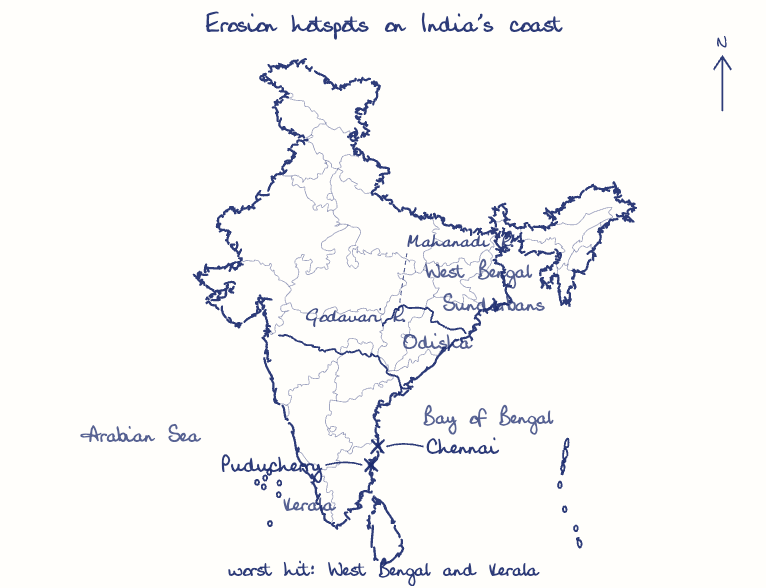
Waves, longshore currents and cyclones such as Amphan (2020) move sand away, while sea-level rise, recorded in the IPCC's Sixth Assessment Report, shrinks Sundarbans islands like Ghoramara.
Human drivers
Dams starve deltas of silt, harbour breakwaters block the littoral drift north of Chennai port, and sand mining at Alappad in Kerala removes natural buffers.
Effects
Satabhaya in Odisha lost most of its land and its families were resettled at Bagapatia, fishers lose landing beaches, turtle-nesting sites vanish, and seawater intrudes into aquifers and farmland.
Hard structures
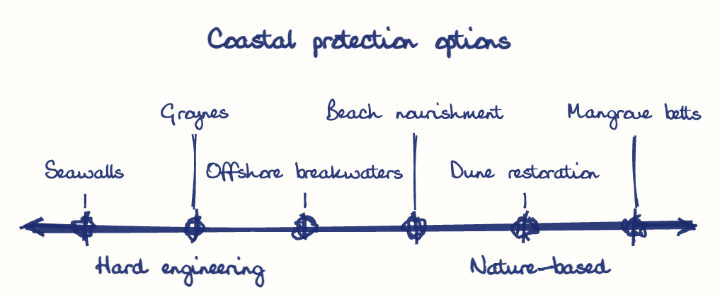
Seawalls and tetrapod revetments, as at Chellanam in Kerala, protect a fixed stretch but often shift erosion onward.
Soft and nature-based methods
NCCR restored Puducherry's beach with a submerged reef and sand nourishment, and the MISHTI scheme (2023) expands mangroves.
Planning tools
The CRZ Notification 2019 sets no-development zones, and INCOIS coastal vulnerability maps show which stretches need protection first.
Integrated planning
Draw shoreline management plans by sediment cell and extend integrated coastal zone management, with fishing communities as partners.
This model answer is indicative and the model can make mistakes; please verify key facts independently.
Practise this question
1Get the answer sheet
Sized for this question.
2Write your answer
Timed, by hand.
3Get it marked
Your score and what to fix.
This chapter in the exam
Conservation19 questions
Asked in 11 of 14 sittings since 2013
- 2026Discuss the aim and goals of Kunming-Montreal global biodiversity framework. Mention India's commitments and initiatives to achieve the goals and targets of this framework giving suitable examples. (Answer in 150 words)
- 2025What is Carbon Capture, Utilization and Storage (CCUS) ? What is the potential role of CCUS in tackling climate change ?
All 19 questions, sorted by sub-topic, with model answers and practice.
Question from the official UPSC Civil Services (Main) Examination 2022 paper. Answer written by Ghissu's engine and checked against our editorial standards. Found an error? Tell us and we correct it within 48 hours.