2023 · GS Paper 1 · Q4 · 10 marks
Discuss the consequences of climate change on the food security in tropical countries.
In short
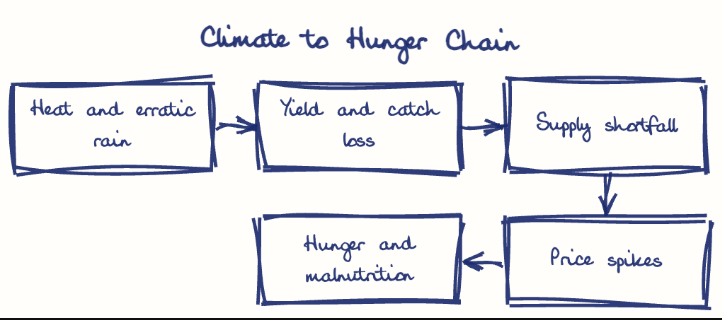
Climate change undermines food security in tropical countries by cutting crop and fish output, lowering farm incomes, reducing the nutrient value of staples and destabilising supplies. IRRI trials found rice yields fall about 10% for every 1°C rise in night temperature.
Model answer
Ghissu Editorial · Verified 4 Oct 2026 · 277 words
Heat-stressed crops
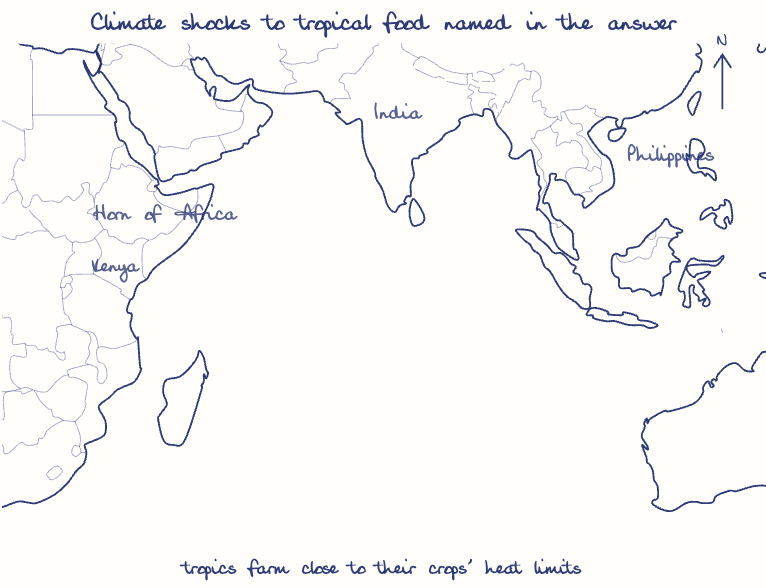
Each 1°C rise in night temperature cut rice yields by about 10% in IRRI trials (2004), and the 2022 heatwave shrivelled India's wheat, forcing an export ban.
Erratic rainfall
Rain-fed farms fail when rains fail, as the Horn of Africa's five failed seasons (2020-23) showed.
Pests and fisheries
Unusual cyclone rains bred the 2019-20 desert locust upsurge from Kenya to Rajasthan, while marine heatwaves bleach the coral reefs that sustain tropical fish stocks.
Falling incomes
The Economic Survey 2017-18 estimated climate change could cut Indian farm incomes by 15-18%, and up to 25% in unirrigated areas, eroding the poor's ability to buy food.
Hidden hunger
Higher carbon dioxide lowers zinc, iron and protein in rice and wheat (Myers et al., 2014), while floods spread diarrhoeal disease that blocks absorption.
Unstable supplies
India's July 2023 curbs on non-basmati rice exports raised prices for import-dependent African buyers.
This model answer is indicative and the model can make mistakes; please verify key facts independently.
Practise this question
1Get the answer sheet
Sized for this question.
2Write your answer
Timed, by hand.
3Get it marked
Your score and what to fix.
This chapter in the exam
Climate12 questions
Asked in 9 of 14 sittings since 2013
- 2026What is the Fujiwara effect? Explain its impact on the movement and intensity of tropical cyclones.
- 2026"Tundra regions are ecologically fragile but economically important." Examine this statement critically.
All 12 questions, sorted by sub-topic, with model answers and practice.
Question from the official UPSC Civil Services (Main) Examination 2023 paper. Answer written by Ghissu's engine and checked against our editorial standards. Found an error? Tell us and we correct it within 48 hours.