2023 · GS Paper 2 · Q8 · 10 marks
e-governance, as a critical tool of governance, has ushered in effectiveness, transparency and accountability in governments. What inadequacies hamper the enhancement of these features?
In short
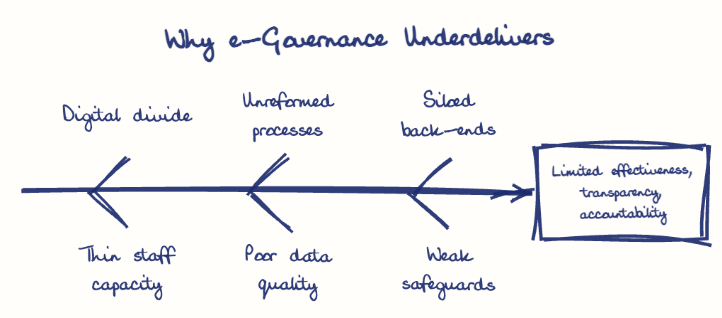
Gaps in digital access, staff capacity, process re-engineering, data quality, database integration and legal safeguards stop e-governance's gains in effectiveness, transparency and accountability from becoming system-wide. Erroneous beneficiary records alone inflate welfare outlays by an estimated 4-7% a year, according to NITI Aayog (2025).
Model answer
Ghissu Editorial · Verified 4 Oct 2026 · 288 words
Digital divide
Only 33.3% of women had ever used the internet (NFHS-5, 2019-21), so portals that assume access miss those who need services most.
Thin human capacity
The Expert Committee on HR Policy for e-Governance (2013) found departments short of skilled staff, leaving projects to outsourced vendors whom no citizen can hold to account.
Last-mile gaps
BharatNet reaches over 2.15 lakh gram panchayats (PIB, 2026), but a fibre link at the panchayat office is not yet working access in every home.
Digitised red tape
The 2nd ARC (2008) warned that computerising without process re-engineering only automates delay, and many services still demand physical copies after online filing.
Poor data quality
Erroneous beneficiary records inflate welfare outlays by an estimated 4-7% a year (NITI Aayog, 2025), and wrong data cannot yield real transparency.
Siloed back-ends
Databases that do not talk to each other make citizens re-submit documents and diffuse accountability.
Weak safeguards
Biometric failures in Jharkhand's PDS denied rations without quick remedy, and the DPDP Act, 2023 widened the RTI Act's personal-information exemption.
This model answer is indicative and the model can make mistakes; please verify key facts independently.
Practise this question
1Get the answer sheet
Sized for this question.
2Write your answer
Timed, by hand.
3Get it marked
Your score and what to fix.
This chapter in the exam
e-Governance — Applications, Models, Successes, Limitations and Potential6 questions
Asked in 6 of 14 sittings since 2013
- 2025e-governance projects have a built-in bias towards technology and back-end integration than user-centric designs. Examine.
- 2024e-governance is not just about the routine application of digital technology in service delivery process. It is as much about multifarious interactions for ensuring transparency and accountability. In this context evaluate the role of the Interactive Service Model of e-governance.
All 6 questions, sorted by sub-topic, with model answers and practice.
Question from the official UPSC Civil Services (Main) Examination 2023 paper. Answer written by Ghissu's engine and checked against our editorial standards. Found an error? Tell us and we correct it within 48 hours.