2023 · GS Paper 2 · Q11 · 15 marks
The Constitution of India is a living instrument with capabilities of enormous dynamism. It is a constitution made for a progressive society. Illustrate with special reference to the expanding horizons of the right to life and personal liberty.
In short
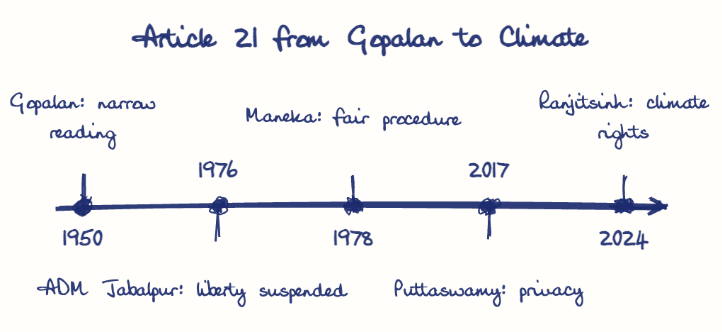
The Constitution stays a living instrument through bounded amendment and purposive judicial interpretation, and Article 21 has grown from a narrow guarantee into a charter of dignified life. Rulings from Maneka Gandhi (1978) to Puttaswamy (2017) and Ranjitsinh (2024) added fair procedure, privacy and climate rights.
Model answer
Ghissu Editorial · Verified 4 Oct 2026 · 285 words
Responsive amendments
The 61st Amendment (1988) lowered the voting age to 18, and the 106th Amendment (2023) reserved one-third of legislative seats for women.
Bounded flexibility
Kesavananda Bharati (1973) allowed change but protected the basic structure, so growth never erased identity, as the NJAC verdict (2015) showed.
Purposive reading
Vishaka (1997) drew workplace harassment rules from CEDAW, and PIL opened courts to the voiceless.
Dignity and livelihood
Francis Coralie Mullin (1981) read in the right to live with human dignity, and Olga Tellis (1985) protected pavement dwellers' livelihood from eviction without hearing.
Social rights
Unni Krishnan (1993) led to Article 21A (2002), and Paschim Banga (1996) guaranteed emergency medical care.
Autonomy and justice
Hussainara Khatoon (1979) secured speedy trial and legal aid, D.K. Basu (1997) curbed custodial torture, while Navtej Singh Johar (2018) and Common Cause (2018) protected identity and dying with dignity.
This model answer is indicative and the model can make mistakes; please verify key facts independently.
Practise this question
1Get the answer sheet
Sized for this question.
2Write your answer
Timed, by hand.
3Get it marked
Your score and what to fix.
This chapter in the exam
Significant Provisions — Fundamental Rights9 questions
Asked in 8 of 14 sittings since 2013
- 2026Right to privacy relating to self-identity is very dear to every human being and well protected under Article 21 of the Constitution. In this context, examine the effect of the amendment in 2026, to the Transgender Persons (Protection of Rights) Act, 2019.
- 2024Right to privacy is intrinsic to life and personal liberty and is inherently protected under Article 21 of the constitution. Explain. In this reference discuss the law relating to D.N.A. testing of child in the womb to establish paternity.
All 9 questions, sorted by sub-topic, with model answers and practice.
Question from the official UPSC Civil Services (Main) Examination 2023 paper. Answer written by Ghissu's engine and checked against our editorial standards. Found an error? Tell us and we correct it within 48 hours.