2024 · GS Paper 1 · Q10 · 10 marks
In dealing with socio-economic issues of development, what kind of collaboration between government, NGOs and private sector would be most productive?
In short
The most productive collaboration is state-anchored, NGO-delivered and privately co-financed, with each sector doing what it does best and funds tied to verified outcomes. Rajasthan's Educate Girls Development Impact Bond (2015-18) paid investors only when enrolment and learning targets were met.
Model answer
Ghissu Editorial · Verified 4 Oct 2026 · 269 words
Poverty, malnutrition and learning deficits are too large for the state alone and too public for markets alone. The most productive collaboration lets each sector do what it does best, keeps the state accountable and ties payment to outcomes, in the spirit of Article 38.
What Each Partner Brings to Development
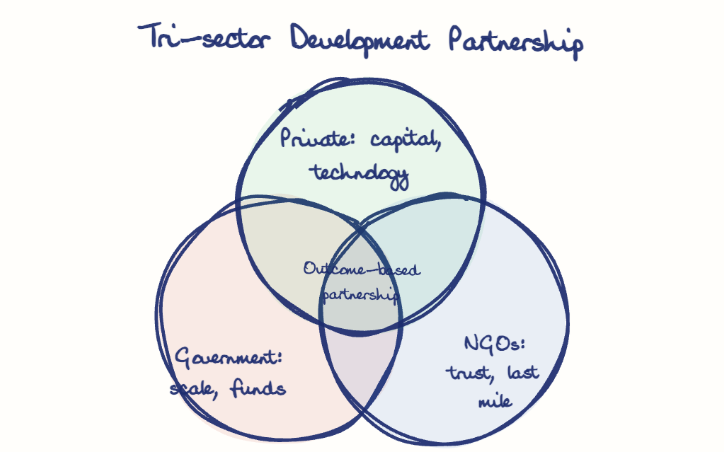
Tri-sector Development Partnership a: Government: scale, funds b: NGOs: trust, last mile c: Private: capital, technology overlap: Outcome-based partnership
1. Government as anchor: The state sets goals, finances at scale and regulates, as the Aspirational Districts Programme (2018) ranks districts on outcome indicators while NITI Aayog's partners, such as Piramal Foundation, support district teams. 2. NGOs as the last mile: Voluntary groups mobilise communities and innovate cheaply, as Pratham's Teaching at the Right Level, adopted by several states, shows. 3. Private sector as enabler: Section 135 of the Companies Act, 2013 channels 2% of eligible companies' average net profit into CSR, adding capital and technology.
Hybrid delivery
The Akshaya Patra Foundation runs mid-day meal kitchens with government grain and cost norms, topped up by corporate donors, feeding lakhs of children daily.
Pay for results
The Educate Girls Development Impact Bond in Rajasthan (2015-18) paid investors only when enrolment and learning targets were met, and it exceeded them.
Transparency safeguards
Since CSR clusters in richer states and NGOs face FCRA compliance burdens, NGO-DARPAN registration and open outcome data keep partnerships accountable.
This model answer is indicative and the model can make mistakes; please verify key facts independently.
Practise this question
1Get the answer sheet
Sized for this question.
2Write your answer
Timed, by hand.
3Get it marked
Your score and what to fix.
This chapter in the exam
Poverty and developmental issues9 questions
Asked in 6 of 14 sittings since 2013
- 2025Achieving sustainable growth with emphasis on environmental protection could come into conflict with poor people's needs in a country like India - Comment.
- 2025How does smart city in India, address the issues of urban poverty and distributive justice ?
All 9 questions, sorted by sub-topic, with model answers and practice.
Question from the official UPSC Civil Services (Main) Examination 2024 paper. Answer written by Ghissu's engine and checked against our editorial standards. Found an error? Tell us and we correct it within 48 hours.