2024 · GS Paper 3 · Q7 · 10 marks
Industrial pollution of river water is a significant environmental issue in India. Discuss the various mitigation measures to deal with this problem and also the government's initiatives in this regard.
In short
Industrial river pollution can be cut through cleaner production, common effluent treatment, zero liquid discharge, online monitoring and the polluter pays principle, backed by the Water Act and Namami Gange. Inspections raised Ganga main-stem industrial compliance from 39% in 2017 to 83% in 2024.
Model answer
Ghissu Editorial · Verified 4 Oct 2026 · 266 words
Prevention at source
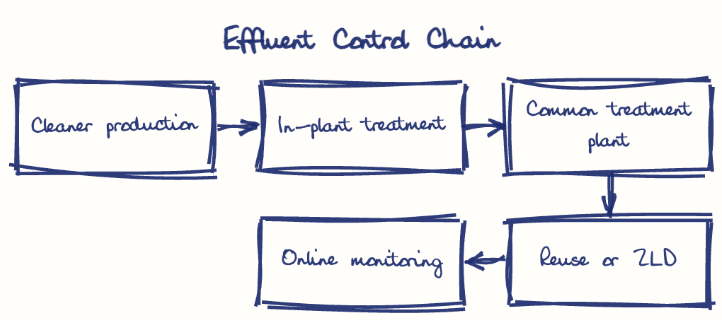
Cleaner production, chrome recovery in tanneries and water recycling cut the load, as Welspun's Anjar unit reuses 30 MLD of treated sewage with zero freshwater for manufacturing (Jal Shakti compendium, 2023).
CETPs and ZLD
Common treatment plants serve small units that cannot afford their own, and Tiruppur's dyeing cluster adopted zero liquid discharge after the Madras High Court's 2011 closure order.
Polluter pays
Online effluent monitoring and environmental compensation apply the principle set in Vellore Citizens Welfare Forum (1996) on Palar tannery pollution.
Legal backbone
The Water Act, 1974 created pollution control boards; its 2024 amendment swapped jail for penalties in minor lapses.
Namami Gange
Inspections of grossly polluting industries raised Ganga main-stem compliance from 39% (2017) to 83% (2024), per the CPCB.
Monitoring
The National Water Quality Monitoring Programme covers 4,922 locations, and NGT-ordered River Rejuvenation Committees plan for each polluted stretch.
Implementation gap
Delhi's 13 CETPs ran at 34% capacity, with 49 of 189 polluting industries non-compliant in 2024 (Standing Committee, 2025).
This model answer is indicative and the model can make mistakes; please verify key facts independently.
Practise this question
1Get the answer sheet
Sized for this question.
2Write your answer
Timed, by hand.
3Get it marked
Your score and what to fix.
This chapter in the exam
Environmental Pollution and Degradation13 questions
Asked in 11 of 14 sittings since 2013
- 2026What are the challenges to solid waste management in India? Discuss the governmental policy framework on solid waste management. Discuss the success/failure cases of Delhi and Indore cities highlighting the salient feature of their solid waste management initiatives. (Answer in 250 words)
- 2025Examine the factors responsible for depleting groundwater in India. What are the steps taken by the government to mitigate such depletion of groundwater ?
All 13 questions, sorted by sub-topic, with model answers and practice.
Question from the official UPSC Civil Services (Main) Examination 2024 paper. Answer written by Ghissu's engine and checked against our editorial standards. Found an error? Tell us and we correct it within 48 hours.