2024 · GS Paper 4 · Q4(b) · 10 marks
"Mindless addiction to Form, ignoring the Substance of the matter, results in rendering of injustice. A perceptive civil servant is one who ignores such literalness and carries out true intent." Examine the above statement with suitable illustrations.
In short
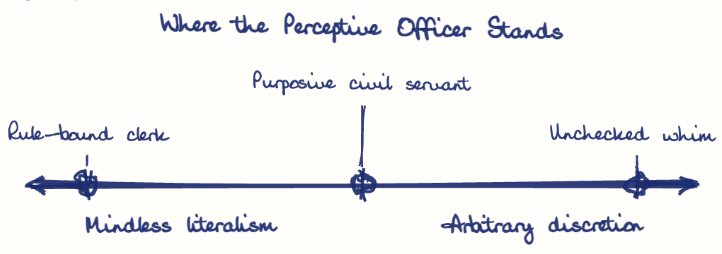
Mindless formalism denies justice, as when Santoshi Kumari died in Jharkhand in 2017 after her ration card was cancelled for want of Aadhaar seeding. A perceptive civil servant reads rules by their purpose, using lawful discretion and recorded reasons rather than ignoring the law.
Model answer
Ghissu Editorial · Verified 4 Oct 2026 · 281 words
Ration denied for a link
In 2017, eleven-year-old Santoshi Kumari of Simdega, Jharkhand, died after her family's ration card was cancelled for not being seeded with Aadhaar.
Treatment held up by paperwork
In Parmanand Katara (1989) the Supreme Court held that doctors must treat accident victims without waiting for police formalities.
Procedure as master
The Court calls procedure "the handmaid of justice", as in State of Punjab v. Shamlal Murari (1976), refusing to let technical defects defeat genuine claims.
Purposive reading
After the Jharkhand deaths, the Centre directed in 2017 that no one be denied ration merely for lack of Aadhaar, reading the rule by its purpose.
Lawful discretion
Relaxation clauses and Gandhi's talisman let an officer reach the last person without breaking the rule book.
Some forms protect rights
The arrest safeguards of D.K. Basu (1997) carry substance, so ignoring them would itself be injustice.
Guarding against arbitrariness
E.P. Royappa (1974) held arbitrariness antithetical to equality, so intent must be shown in recorded reasons.
This model answer is indicative and the model can make mistakes; please verify key facts independently.
Practise this question
1Get the answer sheet
Sized for this question.
2Write your answer
Timed, by hand.
3Get it marked
Your score and what to fix.
This chapter in the exam
Laws, rules, regulations and conscience as sources of ethical guidance16 questions
Asked in 9 of 14 sittings since 2013
- 2026Dr. B. R. Ambedkar had cautioned that employing civil disobedience within a constitutional democracy equates to endorsing 'anarchy'. How should modern democracies navigate the ethical dilemmas posed by civil disobedience movements that aim to promote social justice against policies that may raise genuine concerns?
- 2026Usually schools, working in remote areas, do not fully comply with government regulations. However, if the rules are enforced strictly, it would lead to most schools closing down. How should an administrator strike a balance between enforcement of rules and educational rights of children?
All 16 questions, sorted by sub-topic, with model answers and practice.
Question from the official UPSC Civil Services (Main) Examination 2024 paper. Answer written by Ghissu's engine and checked against our editorial standards. Found an error? Tell us and we correct it within 48 hours.