2024 · GS Paper 4 · Q3(c) · 10 marks
What do each of these quotations convey to you in the present context? "In law, a man is guilty when he violates the rights of others. In ethics, he is guilty if he only thinks of doing so." — Immanuel Kant
In short
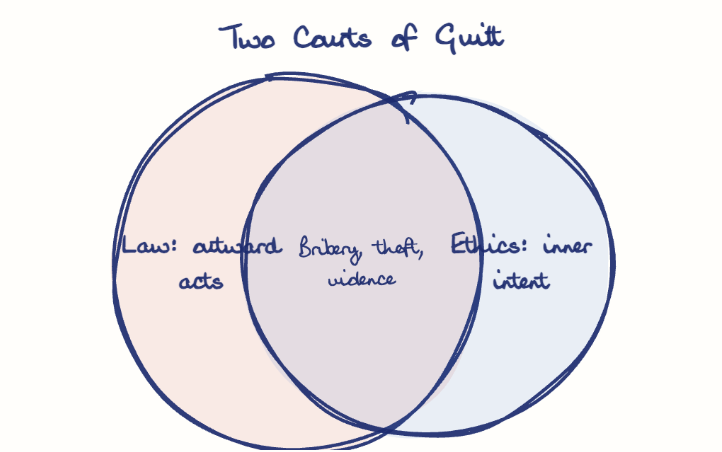
Kant's line means law judges outward acts that harm others, while ethics judges the intention itself, so a person can be morally guilty before any crime. Today it demands integrity in office, such as declaring a conflict of interest before any favour is done.
Model answer
Ghissu Editorial · Verified 4 Oct 2026 · 291 words
Law needs an act
Criminal law punishes a guilty act (actus reus) joined to a guilty mind (mens rea), so a vicious thought is no crime until it becomes an attempt or conspiracy.
Ethics begins in the mind
For Kant, one who avoids fraud only for fear of being caught has no moral worth, since the motive is self-interest, not duty.
Integrity in public office
An officer who privately resolves to favour a relative's firm in a tender breaks no law yet, but has already breached the integrity the Nolan Principles expect; declaring the conflict of interest is the cure.
Law cannot reach prejudice
Article 17 and the Protection of Civil Rights Act, 1955 punish untouchability, but only ethics removes the contempt in the mind; law enforces equality, not fraternity.
The digital age
Online hate and deepfakes begin as a wish to humiliate, and much of it escapes the law, so restraint must come first.
Law moving towards intent
The General Anti-Avoidance Rule, in force since April 2017, examines the main purpose of a tax arrangement.
This model answer is indicative and the model can make mistakes; please verify key facts independently.
Practise this question
1Get the answer sheet
Sized for this question.
2Write your answer
Timed, by hand.
3Get it marked
Your score and what to fix.
This chapter in the exam
Laws, rules, regulations and conscience as sources of ethical guidance16 questions
Asked in 9 of 14 sittings since 2013
- 2026Dr. B. R. Ambedkar had cautioned that employing civil disobedience within a constitutional democracy equates to endorsing 'anarchy'. How should modern democracies navigate the ethical dilemmas posed by civil disobedience movements that aim to promote social justice against policies that may raise genuine concerns?
- 2026Usually schools, working in remote areas, do not fully comply with government regulations. However, if the rules are enforced strictly, it would lead to most schools closing down. How should an administrator strike a balance between enforcement of rules and educational rights of children?
All 16 questions, sorted by sub-topic, with model answers and practice.
Question from the official UPSC Civil Services (Main) Examination 2024 paper. Answer written by Ghissu's engine and checked against our editorial standards. Found an error? Tell us and we correct it within 48 hours.