2025 · GS Paper 1 · Q14 · 15 marks
Give a geographical explanation of the distribution of off-shore oil reserves of the world. How are they different from the on-shore occurrences of oil reserves?
In short
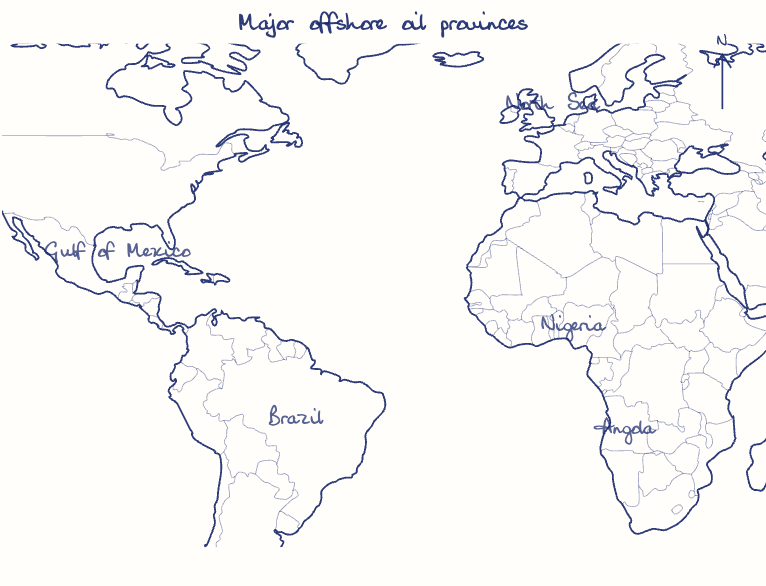
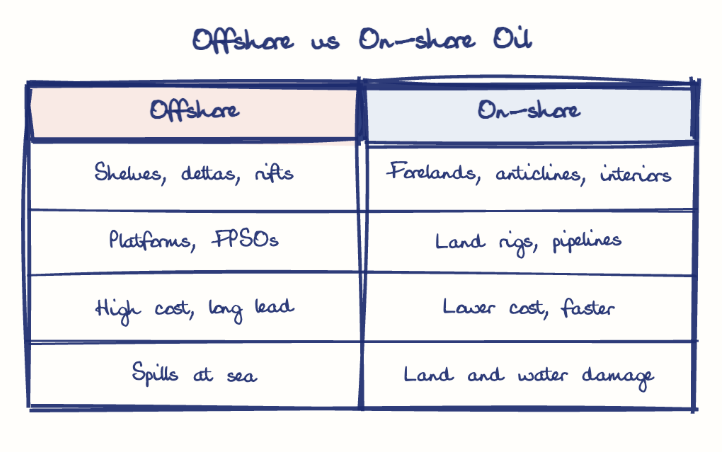
Offshore oil is concentrated on continental shelves, rifted margins and deltas where thick marine sediment buried organic matter, as in the Persian Gulf, North Sea, Gulf of Mexico and Brazil's pre-salt. On-shore oil instead lies in fold-belt anticlines and interior basins such as Ghawar and Digboi.
Model answer
Ghissu Editorial · Verified 4 Oct 2026 · 306 words
Shallow shelves
The Persian Gulf, floored by Tethyan sediments, holds Safaniya in Saudi Arabia, the largest offshore oilfield, and the western Indian shelf holds Mumbai High (1974).
Rifted margins
Gondwana's break-up left pre-salt traps on both sides of the South Atlantic, in Brazil's Santos basin and off Angola, and a rift under the North Sea's Brent field.
Great deltas
The Gulf of Mexico, Niger delta, and Krishna-Godavari basin are delta-fed provinces.
Technology and law
Deepwater rigs work beyond 2,000 m, UNCLOS EEZs decide drilling rights, and the Arctic may hold 13% of undiscovered oil (USGS, 2008).
Setting
On-shore oil sits in fold-belt anticlines and interior basins such as Zagros, Ghawar and Digboi.
History and type
On-shore oil was tapped first, at Drake's well (1859) and Digboi (1889), and on-shore hosts almost all shale oil and Alberta's oil sands.
Risk
Offshore spills like Deepwater Horizon (2010) spread fast, while on-shore damage, as in Ogoniland, is slower but local.
Frontier basins
India's Open Acreage Licensing rounds under HELP (2016) open deepwater KG and Andaman blocks.
This model answer is indicative and the model can make mistakes; please verify key facts independently.
Practise this question
1Get the answer sheet
Sized for this question.
2Write your answer
Timed, by hand.
3Get it marked
Your score and what to fix.
This chapter in the exam
Resources and planning38 questions
Asked in 14 of 14 sittings since 2013
- 2026"Water resources are both an asset and a source of conflict in South Asia." Examine this statement giving examples.
- 2026Analyze the role of satellite-based technologies in achieving climate-smart agriculture and food security in India.
All 38 questions, sorted by sub-topic, with model answers and practice.
Question from the official UPSC Civil Services (Main) Examination 2025 paper. Answer written by Ghissu's engine and checked against our editorial standards. Found an error? Tell us and we correct it within 48 hours.