2025 · GS Paper 3 · Q17 · 15 marks
Mineral resources are fundamental to the country's economy and these are exploited by mining. Why is mining considered an environmental hazard ? Explain the remedial measures required to reduce the environmental hazard due to mining.
In short
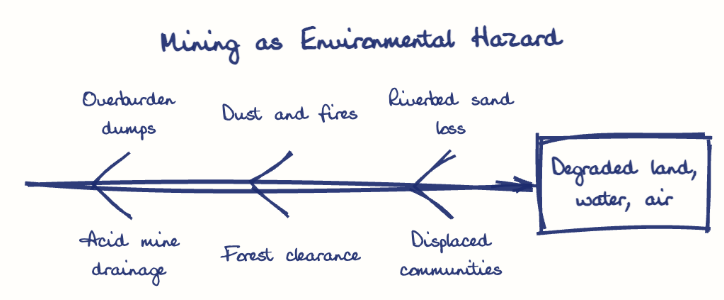
Mining is an environmental hazard because it strips forests and topsoil, poisons water with heavy metals, fills the air with dust and fires, and fuels illegal extraction. Remedies include EIA, progressive mine closure plans, satellite surveillance, District Mineral Foundations and recycling under the National Critical Mineral Mission.
Model answer
Ghissu Editorial · Verified 4 Oct 2026 · 279 words
Land and forest loss
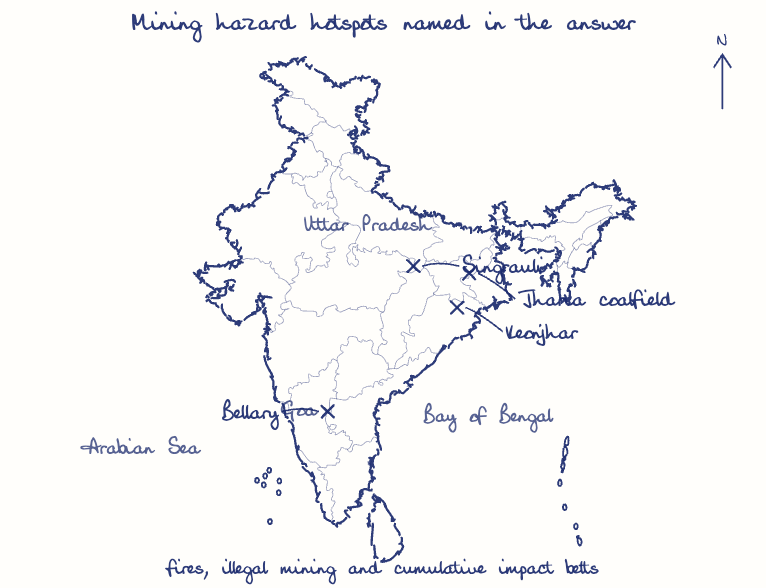
Opencast pits strip topsoil and forest, as in Chhattisgarh's Hasdeo Arand, leaving barren dumps.
Water contamination
Heavy metals and acid drainage poison water, as hexavalent chromium in Odisha's Sukinda valley shows.
Air and fire
Dust causes silicosis, and Jharia's coal fires have burned since 1916.
Illegal mining
The CAG found illegal mining cases in Uttar Pradesh rising from 10,188 (2017-18) to 25,986 (2021-22), much of it riverbed sand.
Clearance and closure
EIA, compensatory afforestation under the CAMPA Act, 2016 and mandatory progressive mine closure plans under the 2017 rules.
On-site technology
Water sprays, covered conveyors, pit backfilling and overburden stabilisation with native grasses.
Surveillance and consent
The satellite Mining Surveillance System and sand mining guidelines (2020) curb illegal pits, while District Mineral Foundations and the Niyamgiri (2013) verdict give communities a share and a voice.
Regional assessment
Carrying-capacity studies for whole belts like Singrauli would capture combined impacts that lease-by-lease clearance misses.
Circular minerals
Scale the NCMM's Rs 1,500 crore recycling incentive to reduce fresh extraction.
This model answer is indicative and the model can make mistakes; please verify key facts independently.
Practise this question
1Get the answer sheet
Sized for this question.
2Write your answer
Timed, by hand.
3Get it marked
Your score and what to fix.
This chapter in the exam
Environmental Pollution and Degradation13 questions
Asked in 11 of 14 sittings since 2013
- 2026What are the challenges to solid waste management in India? Discuss the governmental policy framework on solid waste management. Discuss the success/failure cases of Delhi and Indore cities highlighting the salient feature of their solid waste management initiatives. (Answer in 250 words)
- 2025Examine the factors responsible for depleting groundwater in India. What are the steps taken by the government to mitigate such depletion of groundwater ?
All 13 questions, sorted by sub-topic, with model answers and practice.
Question from the official UPSC Civil Services (Main) Examination 2025 paper. Answer written by Ghissu's engine and checked against our editorial standards. Found an error? Tell us and we correct it within 48 hours.