2026 · GS Paper 2 · Q3 · 10 marks
Examine whether the constitutional office of the Lok Sabha Speaker has become vulnerable to partisan politics under the current anti-defection regime. What institutional changes are required to ensure the neutrality of the Lok Sabha Speaker in managing a polarised House ?
In short
The Lok Sabha Speaker has become vulnerable because the Tenth Schedule made a party-elected presiding officer the final judge of defection, inviting delay and factional rulings. The surest remedy is moving disqualification to an independent tribunal headed by a retired judge, as the Supreme Court suggested in 2020.
Model answer
Ghissu Editorial · Verified 4 Oct 2026 · 302 words
Judge in own cause
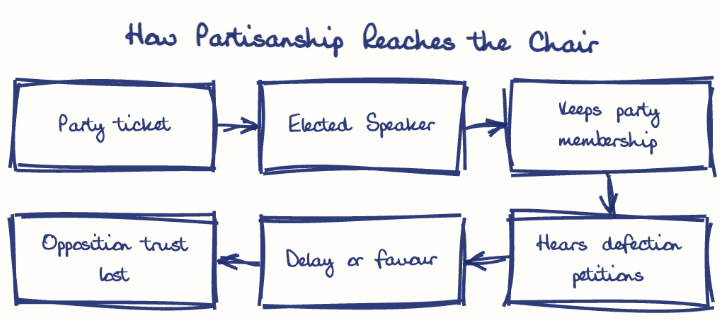
Kihoto Hollohan (1992) upheld the Speaker as a tribunal, but a Speaker who needs the party's ticket again must rule against its own recruits.
Strategic delay
Petitions against a Manipur minister lay pending for nearly three years until the Supreme Court used Article 142 in 2020 to bar him from the Assembly.
Choosing the party
Despite Subhash Desai (2023), the Maharashtra Speaker's 2024 ruling dismissed every petition after naming one faction the real Shiv Sena, though Somnath Chatterjee's stand in 2008 shows the chair can rise above party.
Independent adjudicator
Move disqualification to a tribunal headed by a retired judge, as the Supreme Court suggested in 2020, or to the President and Governors on Election Commission advice, as the Dinesh Goswami Committee (1990) proposed.
Fixed timelines
Write a three-month limit into the Tenth Schedule.
Narrower whip
Confine the whip to votes on the government's survival, per the Law Commission's 170th Report (1999).
Detach from party
Adopt the Westminster practice of the Speaker leaving the party, and fill the Deputy Speaker's post promptly, as Article 93 requires, by convention from the Opposition.
This model answer is indicative and the model can make mistakes; please verify key facts independently.
Practise this question
1Get the answer sheet
Sized for this question.
2Write your answer
Timed, by hand.
3Get it marked
Your score and what to fix.
This chapter in the exam
Parliament — Structure3 questions
Asked in 2 of 14 sittings since 2013
- 2020In the last few decades, Rajya Sabha has transformed from a 'useless stepney tyre' to a most useful supportive organ. Highlight the factors and the areas where this transformation could be visible.
- 2020Once a speaker, Always a speaker! Do you think the practice should be adopted to impart objectivity to the office of the Speaker of Lok Sabha? What could be its implications for the robust functioning of parliamentary business in India.
Question from the official UPSC Civil Services (Main) Examination 2026 paper. Answer written by Ghissu's engine and checked against our editorial standards. Found an error? Tell us and we correct it within 48 hours.