Bring out the nature and characteristic features of the anti-Brahmin movements in Modern India.
In short
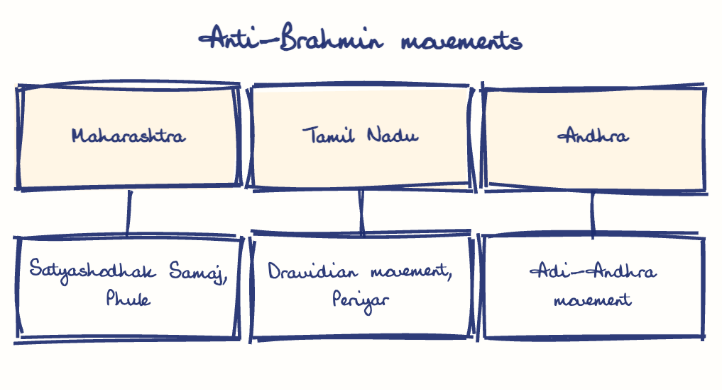
Anti-Brahmin movements were regionally rooted, caste-association based mobilisations of intermediate and lower castes that challenged Brahminical supremacy and demanded education, jobs and representation. Examples include Phule's Satyashodhak Samaj in Maharashtra, Periyar's Dravidian movement in Tamil Nadu and the Adi-Andhra movement, which laid the foundation for affirmative action.
Model answer
Ghissu Editorial · Verified 4 Oct 2026 · 289 words
Caste Associations and Regional Roots
The movements worked through caste associations and conferences, such as the Satyashodhak Samaj (1873) and the Non-Brahman movement in Maharashtra, the Justice Party and Self-Respect Movement in the Madras Presidency, and the Adi-Andhra movement in the Telugu region.
Educated Leadership
Leaders from the intermediate and lower castes, such as Phule, Periyar and Ambedkar, used modern education, the press and public meetings to articulate their communities' grievances.
Anti-Caste Ideology
The core ideology rejected Brahminical supremacy, ritual purity and priestly mediation, culminating in Ambedkar's call for the "annihilation of caste".
Cultural Reinterpretation
The Dravidian movement asserted a non-Brahmin Dravidian identity, self-respect marriages and rationalism, while others reinterpreted religion or turned to Buddhism.
Political Demands
The movements pressed colonial and later Indian governments for reservations in education, jobs and legislatures, as in the Madras communal Government Orders of the 1920s.
Opposition and Divisions
They faced resistance from orthodox sections, internal factionalism and the co-option of leaders by mainstream parties, and their reach in rural areas was limited.
Legacy
They laid the foundation for affirmative action and for later Dalit and backward caste politics, deepening democracy in India.
This model answer is indicative and the model can make mistakes; please verify key facts independently.
Sources
Practise this question
1Get the answer sheet
Sized for this question.
2Write your answer
Timed, by hand.
3Get it marked
Your score and what to fix.
This chapter in the exam
British Rule 1757-1856, the 1857 Revolt, Socio-Religious Reform & the Rise of Nationalism20 questions
Asked in 8 of 8 sittings since 2008
Most tested: Colonialism’s impact on Indian society/economy and reform-led social uplift, especially untouchability and caste reform.
- 2025What do you understand by the Permanent Settlement, and what impact did it have on Indian society? Comment.
- 2025What do you understand by the 'safety valve' theory? Explain it in the context of the Indian National Congress?
All 20 questions, sorted by sub-topic, with model answers and practice.
Question from the official APPSC Group-I Mains 2008 paper. Answer written by Ghissu's engine and checked against our editorial standards. Found an error? Tell us and we correct it within 48 hours.