What do you understand by the 'safety valve' theory? Explain it in the context of the Indian National Congress?
In short
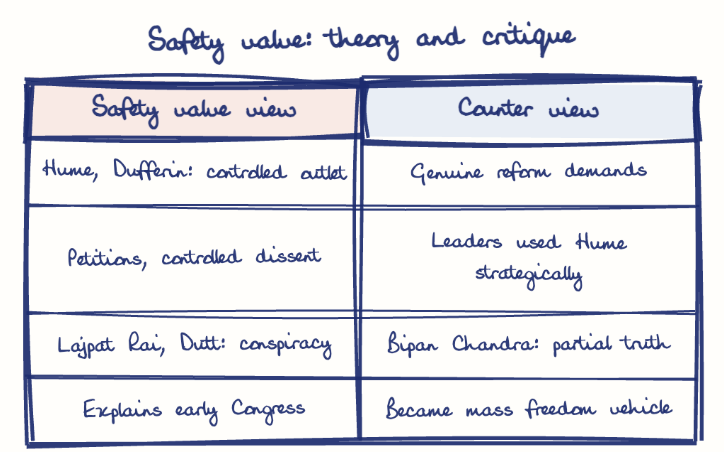
The safety valve theory holds that the British backed A O Hume's founding of the Indian National Congress in 1885 as a controlled outlet for Indian discontent. Bipan Chandra accepts it only partly, since the Congress also voiced genuine nationalism and became the main vehicle of the freedom struggle.
Model answer
Ghissu Editorial · Verified 4 Oct 2026 · 283 words
Conceptual Origin
Articulated by A.O. Hume and popularized by William Wedderburn’s 1913 biography, the theory posits the INC was intended as a pressure release valve for political unrest, based on secret reports from 1878.
Historical Critique
Extremists like Lala Lajpat Rai and Marxist R.P. Dutt viewed the INC as a colonial conspiracy to neutralize revolutionary potential by co-opting Indian leaders into controlled dialogue.
Nuanced View
Bipan Chandra contends the INC also embodied genuine nationalist aspirations, with Indian leaders strategically cooperating with Hume to organize nationalist forces under colonial constraints.
Channeling Discontent
The INC provided a forum for political expression, exemplified by resolutions on famine, poverty and the economic drain, thus preventing spontaneous violent uprisings.
Moderate Leadership
Leaders like Dadabhai Naoroji and Gopal Krishna Gokhale worked within British frameworks, focusing on petitions and reforms, aligning with the safety valve concept of controlled dissent.
Transition to Assertiveness
Events like the 1905 Bengal partition and failure of reforms led to extremist leaders like Bal Gangadhar Tilak rejecting the safety valve role and advocating assertive nationalism.
Catalyst for Nationalism
The INC evolved into the main vehicle for independence, leading mass movements such as Swadeshi and Quit India, showing the theory explains only its initial phase.
This model answer is indicative and the model can make mistakes; please verify key facts independently.
Practise this question
1Get the answer sheet
Sized for this question.
2Write your answer
Timed, by hand.
3Get it marked
Your score and what to fix.
This chapter in the exam
British Rule 1757-1856, the 1857 Revolt, Socio-Religious Reform & the Rise of Nationalism20 questions
Asked in 8 of 8 sittings since 2008
Most tested: Colonialism’s impact on Indian society/economy and reform-led social uplift, especially untouchability and caste reform.
- 2025What do you understand by the Permanent Settlement, and what impact did it have on Indian society? Comment.
- 2023Explain the land revenue systems that were introduced by the British. Assess the impact of these revenue systems on the Indian economy.
All 20 questions, sorted by sub-topic, with model answers and practice.
Question from the official APPSC Group-I Mains 2025 paper. Answer written by Ghissu's engine and checked against our editorial standards. Found an error? Tell us and we correct it within 48 hours.