What do you understand by the Permanent Settlement, and what impact did it have on Indian society? Comment.
In short
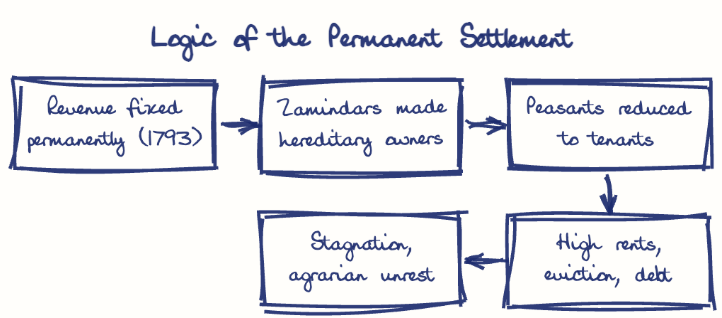
The Permanent Settlement of 1793, introduced by Lord Cornwallis in Bengal, Bihar and Orissa, fixed land revenue permanently and made zamindars hereditary landowners, reducing cultivators to tenants. It created an exploitative landlord class, deepened peasant indebtedness and eviction, stagnated agriculture and provoked anti-zamindari resistance.
Model answer
Ghissu Editorial · Verified 4 Oct 2026 · 291 words
Fixed Revenue and Zamindari Rights
Revenue was fixed permanently, and zamindars became hereditary owners while ryots were reduced to tenants without secure rights.
Revenue Maximization Pressure
Zamindars retained surplus revenue but risked estate auction if they failed to pay, incentivizing high rent extraction from peasants. This pressure often led to harsh rent demands and eviction threats, worsening peasant insecurity.
Peasant Indebtedness and Agricultural Stagnation
Peasants faced poverty and eviction risks, while zamindars neglected agricultural investment, causing stagnation. The lack of incentives for zamindars to improve land productivity contributed to declining agricultural output.
Social Disruption and Resistance Movements
The policy disrupted traditional village structures, provoking uprisings and anti-zamindari agitations that influenced freedom struggles. Movements like the Pabna agrarian leagues (1873) and the Tebhaga movement (1946) reflected peasant resistance to zamindari oppression.
Land Reforms and Tenant Protections
Comprehensive land reforms and laws protecting tenants are essential to dismantle feudal landlordism and secure cultivator rights. The post-independence abolition of zamindari systems in states like Bihar and Uttar Pradesh exemplifies this approach.
Promoting Agricultural Investment and Rural Empowerment
Encouraging investment and decentralized governance can restore productivity and social cohesion. Strengthening Panchayati Raj institutions can empower rural communities in land management.
This model answer is indicative and the model can make mistakes; please verify key facts independently.
Practise this question
1Get the answer sheet
Sized for this question.
2Write your answer
Timed, by hand.
3Get it marked
Your score and what to fix.
This chapter in the exam
British Rule 1757-1856, the 1857 Revolt, Socio-Religious Reform & the Rise of Nationalism20 questions
Asked in 8 of 8 sittings since 2008
Most tested: Colonialism’s impact on Indian society/economy and reform-led social uplift, especially untouchability and caste reform.
- 2025What do you understand by the 'safety valve' theory? Explain it in the context of the Indian National Congress?
- 2023Explain the land revenue systems that were introduced by the British. Assess the impact of these revenue systems on the Indian economy.
All 20 questions, sorted by sub-topic, with model answers and practice.
Question from the official APPSC Group-I Mains 2025 paper. Answer written by Ghissu's engine and checked against our editorial standards. Found an error? Tell us and we correct it within 48 hours.